Rules, Examples & Practice
✏️ Learn How English Works — One Step at a Time!
Grammar helps us put words together so that other people can understand what we mean.
When you learn grammar, you learn how to build sentences, choose the right words, use punctuation and make your writing clearer.
At 3H Club, we make grammar easier by learning one skill at a time, with simple explanations, examples and plenty of practice.
⭐ Starters — Around ages 6–7
⭐⭐ Builders — Around ages 8–9
⭐⭐⭐ Champions — Around ages 10–11
Remember: Ages are only a guide. Start at the level that feels comfortable and move on when you’re ready.
🧭 Jump to a Grammar Skill
🔤 Words & Word Types | 🧩 Sentences | ⏰ Verbs & Tenses | ❗ Punctuation | ✍️ Better Writing | 🎯 Grammar Practice
🌟 What Is Grammar?
Grammar is the set of rules we use to put words together.
Look at these words:
dog • the • runs • fast
Put them in the right order and we can make a sentence:
The dog runs fast.
Now the words make sense!
Grammar helps us understand which words to use, where to put them and how they work together.
Punctuation helps too:
where is my book
becomes:
Where is my book?
A capital letter and question mark tell the reader much more about the sentence.
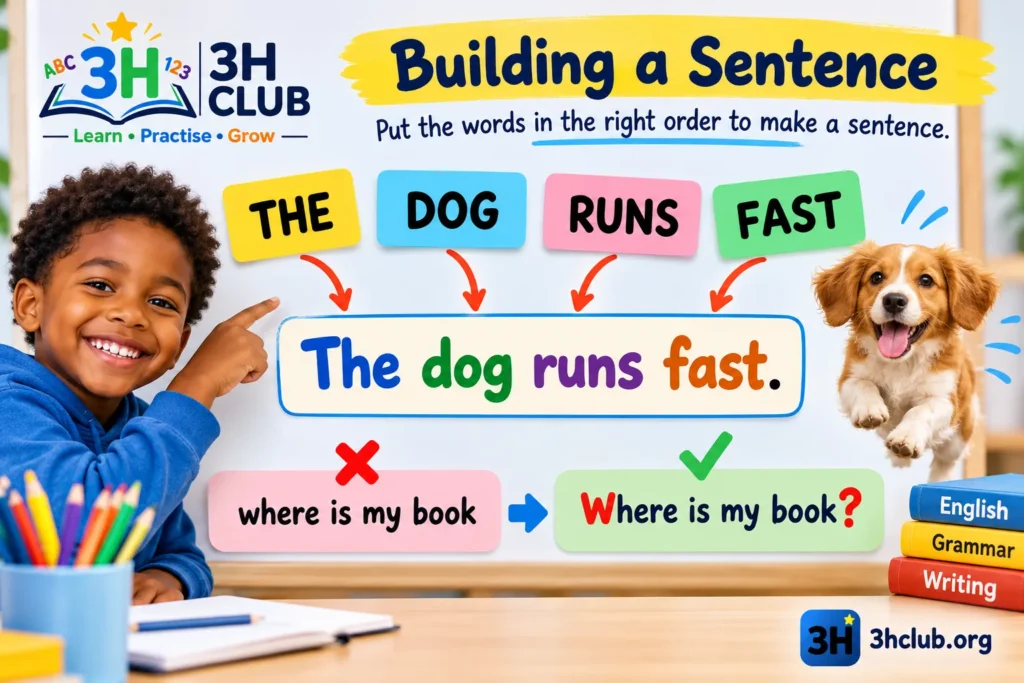
Grammar helps us arrange words to make clear sentences.
⭐ Choose Your Level
⭐ Starters — Around Ages 6–7
🌱 Build Your Grammar Foundations
Start here if you’re learning how words and simple sentences work.
You don’t need to learn everything at once. We’ll begin with the building blocks of English and practise them using short examples.
🔤 Vowels and Consonants
🗣️ Meet the Two Teams of the Alphabet!
Every word we read, write, and say is made using vowels and consonants.
🟥 Vowels are A, E, I, O and U — and sometimes Y joins the vowel team too!
🟦 Consonants are the other letters of the alphabet. When we say them, our lips, teeth or tongue help shape or block the air.
Try saying A-A-A and then B-B-B. Can you feel the difference? 👄
Learning to spot vowels and consonants will help you become better at reading, spelling and building words.
⭐ In This Lesson You’ll Learn:
🔤 Which letters are vowels
🔠 Which letters are consonants
👄 How your mouth makes their sounds
🕵️ Why Y can sometimes be a vowel
✏️ How to find vowels and consonants inside words
👉 Ready to meet the two alphabet teams?
🔵 Nouns — Naming Words
A noun names a person, place, animal or thing.
👧 girl
🐶 dog
🏫 school
⚽ ball
Try it: Which word is the noun?
The cat sleeps.
👉 cat
🟢 Verbs — Action Words
A verb tells us what someone or something is doing.
run • jump • eat • read • play
The boy runs.
Runs is the verb because it tells us what the boy is doing.
🟠 Adjectives — Describing Words
An adjective gives us more information about a noun.
Instead of:
I have a ball.
We could write:
I have a red ball.
The word red describes the ball.
🧩 Building a Sentence
A sentence expresses a complete idea.
The bird sings.
Remember:
🔠 Start with a capital letter.
💬 Make sure the words make sense together.
🔴 Finish with the correct punctuation.
❗Basic Punctuation
Let’s meet some important punctuation marks:
. Full stop — ends a statement.
? Question mark — ends a question.
! Exclamation mark — can show strong feeling or excitement.
And don’t forget capital letters at the beginning of sentences and for names.
⭐ Starter Grammar Checklist
By the end of this level, aim to recognise:
Nouns • Verbs • Adjectives • Simple sentences • Capital letters • Full stops • Question marks • Exclamation marks
⭐ TRY STARTER GRAMMAR PRACTICE →
⭐⭐ Builders — Around Ages 8–9
🚀 Make Your Sentences More Interesting
Ready to build on the basics?
Builders explore more types of words, learn how sentences fit together and begin using grammar to make their writing clearer and more interesting.
👤 Pronouns
A pronoun can take the place of a noun.
Instead of:
Amelia has a book. Amelia is reading the book.
We can write:
Amelia has a book. She is reading it.
She and it are pronouns.
🔗 Conjunctions
Conjunctions help connect words and ideas.
Some common conjunctions are:
and • but • because • so • or
I took my umbrella because it was raining.
The word because connects the two ideas.
⏰ Past, Present and Future Tense
Verbs can tell us when something happens.
PAST: I walked to school.
PRESENT: I walk to school.
FUTURE: I will walk to school.
Look at the verb carefully. Changing it can change the time of the whole sentence.
📚 Singular and Plural
Singular means one.
one book
Plural usually means more than one.
three books
But not every plural is made by adding -s:
child → children
mouse → mice
tooth → teeth
English likes to give us a few surprises!
📝 Commas
Commas help organise information and make sentences easier to read.
For example, we can use commas in a list:
I packed a pencil, ruler, notebook and eraser.
You’ll discover other uses for commas as your grammar skills grow.
🧩 Building Better Sentences
Compare these:
The dog ran.
The excited dog ran quickly across the garden.
Both are correct, but the second sentence gives the reader much more information.
Grammar isn’t just about avoiding mistakes. It gives you tools for better writing.
⭐⭐ Builder Grammar Checklist
Work towards understanding:
Pronouns • Conjunctions • Adverbs • Singular and plural • Past/present/future tense • Commas • Sentence structure • Expanded sentences
⭐⭐ TRY BUILDER GRAMMAR PRACTICE →
⭐⭐⭐ Champions — Around Ages 10–11
🏆 Take Your Grammar Further
Champions explore how sentences can become more detailed and sophisticated.
You’ll start thinking not only about whether a sentence is correct, but also about how you can improve it.
🧱 Subjects and Predicates
Most complete sentences tell us who or what we’re talking about and what happens.
The enormous brown dog | chased the ball.
Subject: The enormous brown dog
Predicate: chased the ball
Recognising these parts helps us understand how sentences are constructed.
🔗 Clauses
A clause is a group of words containing a subject and a verb.
I stayed inside because it was raining.
There are two ideas here:
I stayed inside
and
because it was raining
Learning how clauses work helps you create more detailed sentences.
⏳ More About Verbs & Tenses
As your writing develops, you’ll meet different forms of past, present, and future tense.
Compare:
I play football.
I am playing football.
I played football.
I have played football.
The form of the verb tells the reader something about when and how an action happens.
💬 Direct Speech
When we write someone’s exact words, we use quotation marks or speech marks.
“I found it!” shouted Maya.
You’ll need to think about:
quotation marks • capital letters • punctuation • reporting clauses
✍️ Choosing Better Sentences
Good writers vary their sentences.
Instead of repeatedly writing:
The boy walked into the cave. It was dark. He was scared. He heard a noise.
You might write:
The boy walked cautiously into the dark cave. Suddenly, he heard a strange noise behind him.
Grammar gives you choices about how to communicate your ideas effectively.
⭐⭐⭐ Champion Grammar Checklist
Develop your understanding of:
Subjects and predicates • Clauses • Complex sentences • Verb forms and tenses • Direct speech • Apostrophes • Commas • Sentence variety • Editing and proofreading
⭐⭐⭐ TRY CHAMPION GRAMMAR PRACTICE →
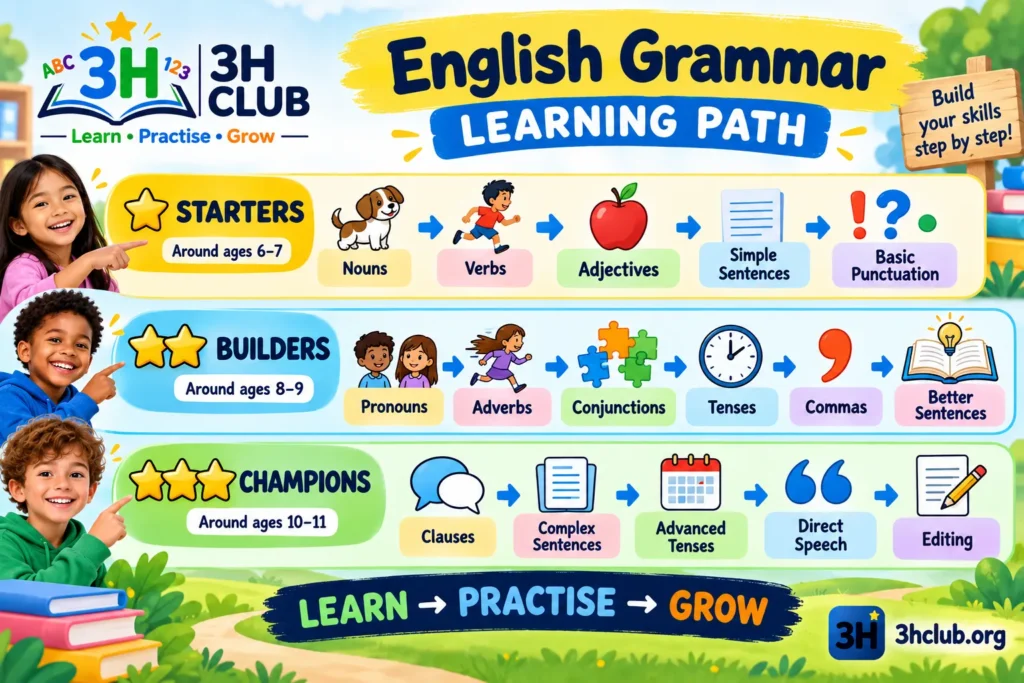
Follow the 3H Club grammar path from Starter to Champion.
🔤 Parts of Speech
Words have different jobs.
| Word type | What it does | Example |
|---|---|---|
| 👤 Noun | Names something | dog |
| 🏃 Verb | Shows an action or state | runs |
| 🎨 Adjective | Describes a noun | fast dog |
| 🚀 Adverb | Adds information to a verb | runs quickly |
| 👧 Pronoun | Replaces a noun | she |
| 🔗 Conjunction | Joins ideas | because |
| 📍 Preposition | Shows position or relationship | under |
| 👉 Determiner | Introduces a noun | the dog |
Here’s a challenge:
The happy dog ran quickly across the garden.
Can you find the noun, adjective, verb and adverb?
❗ Punctuation Matters!
Punctuation tells your reader how to understand a sentence.
Compare:
Let’s eat Grandma!
and
Let’s eat, Grandma!
That tiny comma makes quite a difference!
As you progress through 3H Club, you’ll learn to use:
. Full stops
, Commas
? Question marks
! Exclamation marks
‘ Apostrophes
” ” Quotation marks
: Colons
and more.
🔍 Become a Grammar Detective
Can you spot what’s wrong with this sentence?
my sister have two cat
Think about:
🔠 Does it need a capital letter?
🧩 Does the verb agree with the subject?
🔢 Are there one or two cats?
🔴 Does it need punctuation?
✔ Corrected sentence:
My sister has two cats.
Great grammar detectives don’t just find mistakes — they work out why something needs changing.
🔍 TRY MORE GRAMMAR CHALLENGES →
🎯 Learn → Practise → Grow
The best way to improve your grammar is to use it.
📚 LEARN
Read a short lesson and look carefully at the examples.
✏️ PRACTISE
Try questions and activities until the skill begins to feel familiar.
🌱 GROW
Use what you’ve learned in your own sentences, stories and schoolwork.
You don’t have to get everything right the first time.
Every bit of practice helps your English grow stronger.
👨👩👧 For Grown-Ups
3H Club’s age ranges are guides rather than strict grade boundaries. A child can start with an easier activity to build confidence or move ahead when they are ready — consistent with the approach already explained on your English hub. (3hClub.org)
Encourage children to explain why an answer is correct rather than simply choosing the correct answer.
For example, instead of only asking:
“Which word is the verb?”
follow with:
“How do you know?”
Explaining a grammar rule is an excellent way to strengthen understanding.
🌟 Ready to Practise Your Grammar?
Choose a level and give it a try.
⭐ STARTERS (6-7) — Build the foundations
⭐⭐ BUILDERS (8-9) — Develop your skills
⭐⭐⭐ CHAMPIONS (10-11) — Take on a challenge
Learn • Practise • Grow