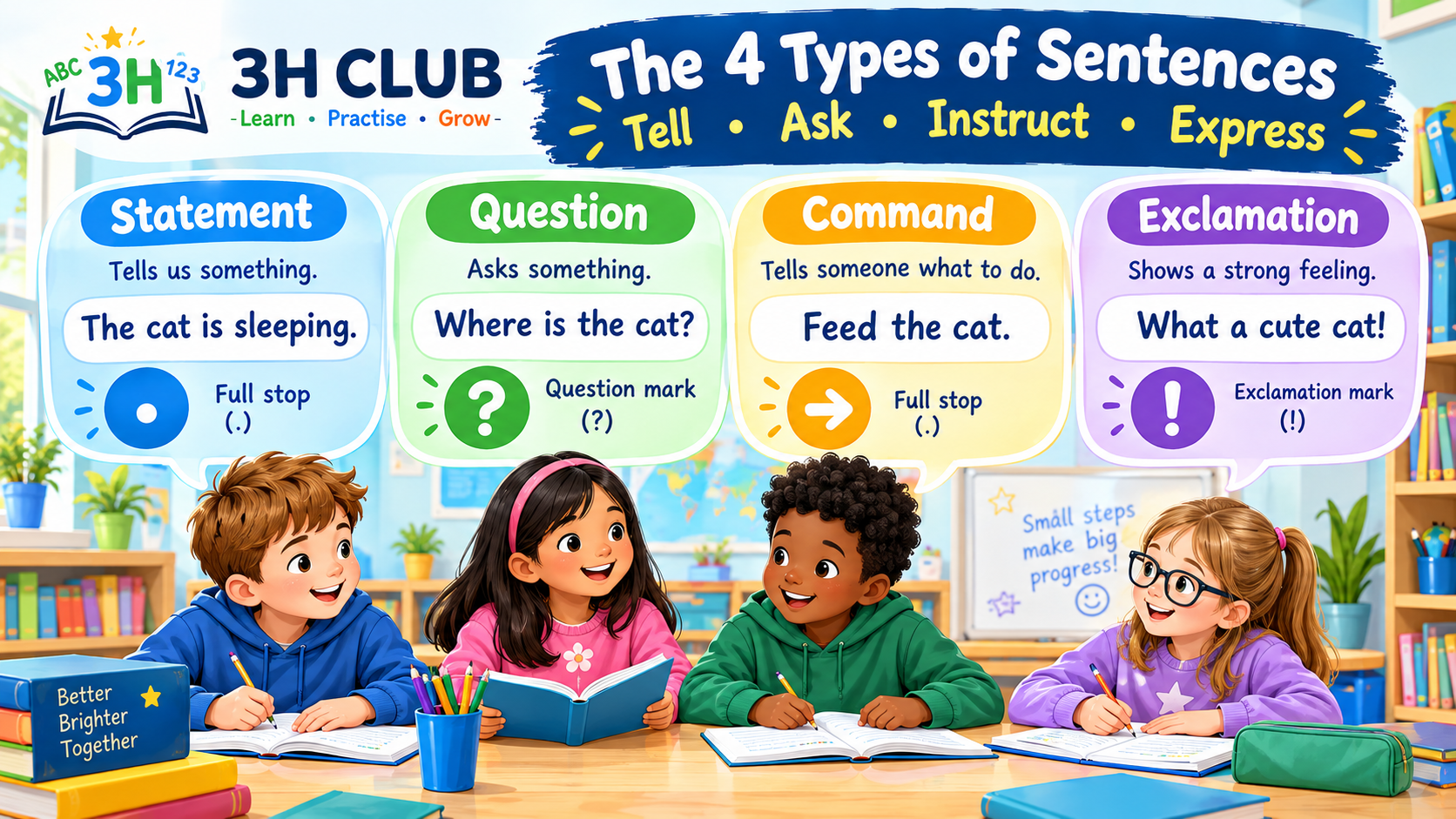
The 4 Types of Sentences
A Simple Guide with Examples and Fun Practice
💬 📣 ❓ ✏️ Learn how statements, questions, commands and exclamations help you share ideas, ask questions, give instructions and express feelings!
Have you ever asked a question, told someone a fact, given an instruction or shouted, “What an amazing day!”?
You have already used different types of sentences!
Sentences help us communicate clearly. They tell people what we know, what we want to find out, what to do and how we feel. Once you understand the four types of sentences, you can make your speaking and writing more interesting.
Let’s explore them together!
🔤 What Are the 4 Types of Sentences?
There are four main types of sentences, and each one has a different job.
| Type of sentence | What it does | Example |
|---|---|---|
| 📘 Statement | Tells us something | The dog is sleeping. |
| ❓ Question | Asks something | Where is the dog? |
| 👉 Command | Tells someone to do something | Please feed the dog. |
| 🎉 Exclamation | Expresses a strong feeling or reaction | What a lovely dog! |
💡 Quick Answer
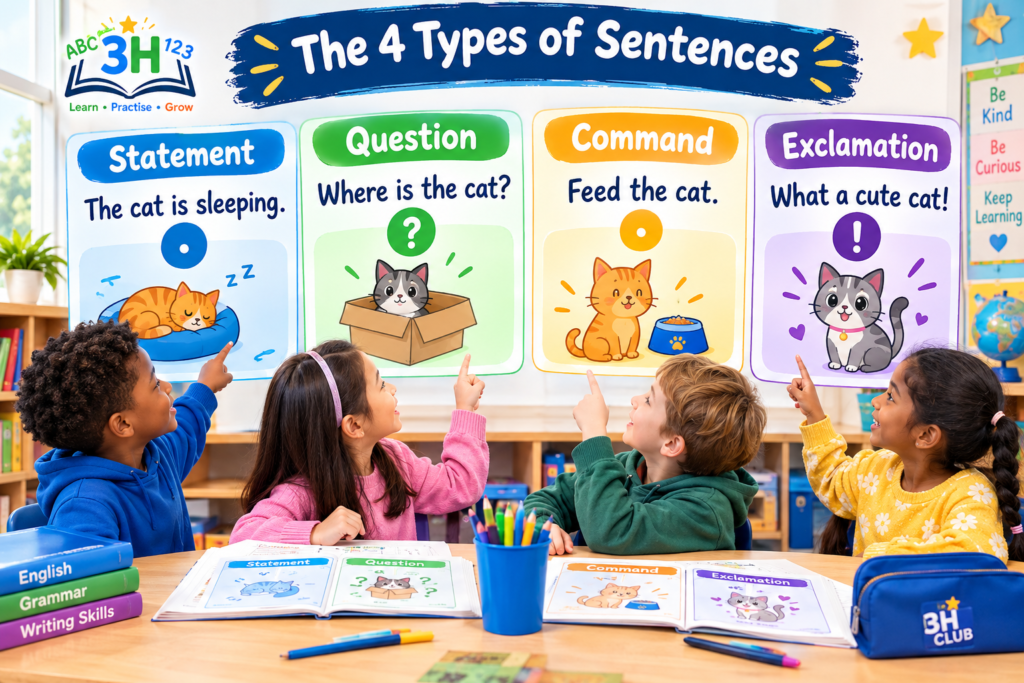
The four types of sentences are statements, questions, commands and exclamations.
Look at how they work with the same topic:
- 📘 Statement: The puppy is very playful.
- ❓ Question: Is the puppy playful?
- 👉 Command: Play gently with the puppy.
- 🎉 Exclamation: What a playful puppy!
Notice how each sentence has a different purpose, even though all four are about a puppy.
👀 Try This
Imagine you are at the beach.
Can you think of:
- One sentence that tells someone something about the beach?
- One sentence that asks a question about the beach?
- One sentence that gives someone an instruction?
- One sentence that shows excitement about the beach?
You have already started practicing the four types of sentences!
⭐ Starters: Let’s Meet the 4 Types of Sentences!
Around ages 6–7
Sentences help you tell people what you think, ask questions and share your feelings.
Let’s meet each type.
📘 1. Statements Tell Us Something
A statement tells us something. It might share a fact, an idea or an opinion.
Examples:
- The sun is shining.
- I have a blue pencil.
- My favorite animal is a dolphin.
- We play at school.
Most statements end with a full stop (.).
Look at this example:
The cat is sleeping.
This sentence tells us what the cat is doing. It is a statement.
👀 Your Turn
Which sentence tells us something?
A. Where is my bag?
B. My bag is under the table.
C. Pick up my bag.
Answer: B. It tells us where the bag is.
❓ 2. Questions Ask Us Something
A question asks for information. It might ask about a person, a place, an object or something that happened.
Examples:
- What is your name?
- Where is my book?
- Can you swim?
- When is lunch?
Questions end with a question mark (?).
Look at this example:
Where is my teddy bear?
The sentence asks where something is, so it is a question.
Many questions begin with words such as who, what, where, when, why or how. Other questions begin with words such as is, can, do or will.
👀 Your Turn
Which sentence is a question?
A. The bird is in the tree.
B. Is the bird in the tree?
C. Look at the bird.
Answer: B. It asks something and ends with a question mark.
👉 3. Commands Tell Someone What to Do
A command tells someone to do something. It can give an instruction, make a request or offer advice.
Examples:
- Close the door.
- Please pass the crayons.
- Wash your hands.
- Look both ways before crossing.
Commands often begin with an action word, such as close, pass, wash or look.
Most commands end with a full stop (.). A strong or urgent command may end with an exclamation mark (!).
For example:
Stop!
This is a command because it tells someone what to do.
💡 Remember
A command does not always sound bossy. Adding please can make it more polite.
Compare:
- Give me the pencil.
- Please give me the pencil.
Both are commands.
👀 Your Turn
Which sentence gives an instruction?
A. The pencil is yellow.
B. Where is the pencil?
C. Put the pencil in your bag.
Answer: C. It tells someone what to do.
🎉 4. Exclamations Show Strong Feelings
An exclamation expresses a strong feeling or reaction, such as surprise, excitement, delight or shock.
Examples:
- What a beautiful rainbow!
- How exciting this game is!
- What a huge cake!
- How quickly the rabbit runs!
Exclamations end with an exclamation mark (!).
Read this example:
What a wonderful surprise!
The sentence expresses excitement and wonder.
💡 Remember
An exclamation mark can also appear at the end of a command or a statement. The punctuation mark alone does not always tell you the sentence type.
For example:
- Watch out! — command
- That was amazing! — statement expressing excitement
- What an amazing day! — exclamation
For now, look at what the sentence is doing as well as the punctuation at the end.
👀 Your Turn
Which sentence expresses a strong feeling?
A. I have a new game.
B. What an exciting game!
C. Do you have a game?
Answer: B. It expresses excitement.
🎯 Starters Activity: Can You Spot the Sentence Type?
Choose the correct answer for each question.
1. Which sentence is a statement?
A. The children are playing.
B. Are the children playing?
C. Play with the children.
2. Which sentence asks something?
A. My lunch is ready.
B. Is my lunch ready?
C. Eat your lunch.
3. Which sentence gives an instruction?
A. The door is open.
B. Is the door open?
C. Close the door.
4. Which sentence expresses excitement?
A. We won the game.
B. Did we win the game?
C. What an exciting game!
5. Add the correct punctuation mark.
Where is my hat ___
6. Add the correct punctuation mark.
Please sit down ___
7. Add the correct punctuation mark.
What a beautiful flower ___
8. Write your own sentences.
Write one sentence that:
- Tells something.
- Asks something.
- Gives an instruction.
- Shows a strong feeling.
✅ Check Your Answers
- A — statement
- B — question
- C — command
- C — exclamation
- Question mark (?)
- Full stop (.) is suitable for a polite instruction.
- Exclamation mark (!)
- Answers will vary. For example:
- Statement: I like mangoes.
- Question: Do you like mangoes?
- Command: Share the mangoes, please.
- Exclamation: What a tasty mango!
⭐ Starters Tip: Ask yourself, “What is this sentence doing?” Is it telling, asking, instructing or expressing a strong feeling?
⭐⭐ Builders: Discover How Sentences Work
Around ages 8–9
You now know the four main types of sentences. Next, let’s look more closely at how they work and how punctuation helps readers understand them.
📘 Statements: Facts, Ideas and Opinions
A statement gives information. It can tell a fact, share an idea or express an opinion.
Facts:
- A week has seven days.
- Birds have feathers.
- Water can freeze into ice.
Ideas and opinions:
- Reading is a useful habit.
- I think football is exciting.
- Our school garden looks beautiful.
Statements usually end with a full stop.
Remember that an opinion is something a person thinks or feels. It may not be something everyone agrees with.
For example:
Chocolate ice cream is the best flavour.
This is a statement because it shares an opinion.
❓ Questions: Finding Out More
Questions help us discover information, check something or invite someone to explain an idea.
Here are some useful question words:
| Question word | What it asks about | Example |
|---|---|---|
| Who | A person or people | Who found the key? |
| What | A thing, action or idea | What happened? |
| Where | A place | Where is the library? |
| When | A time | When does the film start? |
| Why | A reason | Why are the leaves falling? |
| How | A way or manner | How did you solve it? |
Every direct question needs a question mark at the end.
Compare these sentences:
- You finished your homework. — statement
- Did you finish your homework? — question
The second sentence asks for information, so it ends with a question mark.
👉 Commands: Instructions, Requests and Advice
Commands are useful when you want someone to do something.
You might find them in recipes, classroom instructions, signs, games and safety rules.
Examples:
- Mix the flour and water.
- Turn left at the next street.
- Please wait here.
- Remember to bring your notebook.
- Do not touch the hot pan.
Many commands begin with an imperative verb. This is the verb that tells someone what action to take.
In the sentence “Open your notebook,” the imperative verb is open.
Sometimes the person receiving the instruction is not named. The sentence still makes sense because the reader understands who should act.
For example:
Put your books away.
The instruction is meant for the person being spoken to.
💡 Builder Tip
A command can end with a full stop or an exclamation mark, depending on its tone.
- Please wait outside. — a calm instruction
- Stop! — an urgent command
Both are commands because both tell someone what to do.
🎉 Exclamations: Making Strong Feelings Clear
Exclamations help writers express strong feelings or reactions.
Examples:
- What a fantastic goal!
- How bright the stars are!
- What an enormous wave!
- How wonderful the performance was!
Many exclamations begin with what or how.
Compare:
- The wave is enormous. — a statement
- Is the wave enormous? — a question
- What an enormous wave! — an exclamation
The meaning changes because each sentence has a different purpose.
⚠️ A Useful Difference
Do not confuse an exclamation with every sentence that ends in an exclamation mark.
Look at these examples:
| Sentence | Type | Why? |
|---|---|---|
| The team won! | Statement | It tells us what happened. |
| Did the team win? | Question | It asks for information. |
| Celebrate the victory! | Command | It tells someone what to do. |
| What an incredible victory! | Exclamation | It expresses a strong reaction. |
The punctuation is important, but the sentence’s purpose matters too.

🎯 Builders Activity: Choose, Classify and Correct
1. Identify the type of sentence.
“The library closes at four o’clock.”
2. Identify the type of sentence.
“Why is the sky so cloudy?”
3. Identify the type of sentence.
“Please put your shoes by the door.”
4. Identify the type of sentence.
“What a brilliant performance!”
5. Find the imperative verb.
“Carefully carry the tray.”
6. Add the correct punctuation.
“How far is the beach ___”
7. Correct the punctuation.
“Where did you leave your bag.”
8. Is this a command or an exclamation?
“Look out!”
Explain your answer.
9. Is this a statement or an exclamation?
“What a clever idea!”
10. Write four sentences about a school trip.
Write one statement, one question, one command and one exclamation.
11. Improve the sentence.
Rewrite this sentence as a question:
“You can ride a bicycle.”
12. Improve the sentence.
Rewrite this sentence as a polite command:
“Give me the ruler.”
✅ Builders: Check Your Answers
- Statement
- Question
- Command
- Exclamation
- Carry
- Question mark (?)
- “Where did you leave your bag?”
- It is a command because it tells someone to look out. The exclamation mark shows urgency.
- Exclamation. It expresses a strong reaction to the idea.
- Answers will vary. For example:
- Statement: Our class visited the museum.
- Question: What was your favourite exhibit?
- Command: Stay with your group, please.
- Exclamation: What an amazing dinosaur skeleton!
- “Can you ride a bicycle?”
- “Please give me the ruler.”
⭐⭐ Builder Tip: Read your sentence aloud. Think about its purpose, then check that its punctuation helps the reader understand it.
⭐⭐⭐ Champions: Take Your Sentence Skills Further
Around ages 10–11
You have learned to identify statements, questions, commands and exclamations. Now let’s explore how sentence types can make your writing clearer, more precise and more engaging.
🔍 1. Understand the Difference Between Form and Purpose
The four sentence types are often taught according to what a sentence does. In grammar, they are also associated with different structures.
| Sentence type | Main purpose | Common feature |
|---|---|---|
| Statement | To tell or state something | Often uses ordinary subject–verb word order |
| Question | To ask something | Often begins with a question word or helping verb |
| Command | To instruct or request | Often begins with an imperative verb |
| Exclamation | To express a strong reaction | Often uses what or how in an exclamatory structure |
These are useful patterns, not rules that every sentence must follow in exactly the same way.
For example, a question can be asked without using a question word:
Have you finished the puzzle?
A command can be very short:
Wait!
And a statement can express strong emotion:
We finally won!
This is why you should look at both the structure and the meaning of a sentence.
📘 2. Statements Can Share Facts, Opinions and Explanations
Statements are essential in reports, stories, explanations and persuasive writing.
Consider these examples:
- Fact: The Earth travels around the Sun.
- Opinion: Space exploration is fascinating.
- Explanation: Plants need light to make their own food.
- Story detail: A mysterious sound came from the attic.
Each sentence gives the reader information. However, the kind of information changes.
When writing a report, you may use many factual statements. In a story, you might use statements to describe characters, places and events.
❓ 3. Questions Can Do More Than Ask for Facts
Questions can help you gather information, encourage thinking or create suspense.
Information question: Where did the explorers land?
Thinking question: Why do you think the character made that choice?
Rhetorical question: Who wouldn’t want a day at the beach?
A rhetorical question is asked for effect rather than to receive a direct answer. It is common in speeches, advertisements and persuasive writing.
Remember: a direct question ends with a question mark, including a rhetorical question.
👉 4. Commands Can Guide the Reader
Commands are especially useful in instructions and persuasive writing.
Instructions:
- Measure the water carefully.
- Pour it into the container.
- Stir the mixture slowly.
Advice:
- Read the question twice.
- Check your calculations.
- Remember to include evidence.
Persuasion:
- Protect our oceans.
- Choose reusable bags.
- Help keep the playground clean.
Commands often use an understood subject, you. In “Protect our oceans,” the sentence does not say “you”, but the instruction is directed at the reader or listener.
💡 Champion Tip
A command can sound encouraging, polite, urgent or forceful. The verb, word choice and punctuation help create that tone.
Compare:
- “Please check your answer.” — polite instruction
- “Check your answer now!” — forceful instruction
Both are commands, but they sound different.
🎉 5. Exclamations Add Emphasis
Exclamations can make a reaction stand out. They often appear in dialogue, stories and expressive writing.
Examples:
- What a remarkable discovery!
- How beautifully the birds sing!
- What an extraordinary adventure!
- How quickly the time has passed!
Use exclamations thoughtfully. If every sentence expresses extreme excitement, the strongest moments may lose their impact.
Compare:
Too much: The door opened! The room was dark! The floor creaked! A shadow moved!
More controlled: The door opened. The room was dark, and the floor creaked beneath my feet. Then a shadow moved!
Both versions may suit different styles, but the second builds suspense by saving the most dramatic moment.
✍️ 6. Use Different Sentence Types in the Same Piece of Writing
A good piece of writing often uses a mixture of sentence types.
Imagine you are writing a poster to encourage people to protect the environment.
Statement: Plastic waste can harm sea animals.
Question: What can we do to reduce plastic waste?
Command: Reuse bags and bottles whenever possible.
Exclamation: What a difference one small action can make!
Each sentence contributes something different. The statement gives information, the question invites thought, the command encourages action and the exclamation expresses enthusiasm.
When you revise your writing, ask yourself:
- Have I explained my main ideas clearly?
- Could a question help the reader think?
- Would a command make an instruction easier to follow?
- Is an exclamation useful here, or would a full stop be stronger?
Using a variety of sentence types helps your writing feel purposeful rather than repetitive.

🎯 Champions Challenge: Think Like a Grammar Expert
1. Identify the sentence type.
“Several birds nested in the old tree.”
2. Identify the sentence type.
“Could you explain your answer?”
3. Identify the sentence type.
“Remember to label each part of your diagram.”
4. Identify the sentence type.
“What a spectacular view!”
5. Explain the purpose.
“Who wouldn’t enjoy a day off?”
Is this an ordinary information question or a rhetorical question?
6. Explain the punctuation.
“Stop!”
Why is this still a command, even though it ends with an exclamation mark?
7. Rewrite the sentence.
Change the statement into a question:
“The train arrives at noon.”
8. Rewrite the sentence.
Change the command into a polite request:
“Move your chair.”
9. Improve the writing.
Rewrite the following short passage using a more suitable mixture of sentence types:
“The school fair opens on Friday. You should come to the fair. The games will be fun. You should bring your friends.”
There are several possible answers. Try including a question and an exclamation without using too many exclamation marks.
10. Correct the punctuation and capital letters.
“where is the science lab”
11. Explain the difference.
- “The cake looks wonderful.”
- “What a wonderful cake!”
How does the purpose of each sentence differ?
12. Write a short paragraph.
Imagine your class is planning a visit to a wildlife park. Write four sentences:
- One statement giving information.
- One question asking about the visit.
- One command or polite instruction.
- One exclamation expressing a strong reaction.
Underline or label each sentence type.
✅ Champions: Check Your Answers
- Statement
- Question
- Command
- Exclamation
- It is a rhetorical question. The writer is inviting the reader to agree or think about the idea, rather than simply asking for information.
- It tells someone to stop, so its purpose is a command. The exclamation mark makes it sound urgent or forceful.
- “Does the train arrive at noon?”
- “Please move your chair.”
- Answers will vary. Example: “The school fair opens on Friday. Would you like to join us? Bring your friends along. What a fun day it will be!”
- “Where is the science lab?”
- The first sentence states an observation. The second expresses a stronger reaction to the cake.
- Answers will vary. Example:
- Statement: Our class is visiting a wildlife park next week.
- Question: Which animals will we see?
- Command: Please stay with your group during the visit.
- Exclamation: What an incredible place to explore!
⭐⭐⭐ Champion Tip: Great writers do more than identify sentence types. They choose them to match the purpose, audience and tone of their writing.
🧠 Big Sentence Challenge
Ready to test all four sentence types?
⭐ 1. Which sentence asks a question?
A. The rain is falling.
B. Is the rain falling?
C. Watch the rain.
⭐ 2. Which sentence is a command?
A. Please open the window.
B. The window is open.
C. Is the window open?
⭐ 3. Which sentence is an exclamation?
A. The cake is delicious.
B. Is the cake delicious?
C. What a delicious cake!
⭐⭐ 4. What type of sentence is this?
“The library is closed today.”
⭐⭐ 5. What type of sentence is this?
“Why did the lights go out?”
⭐⭐ 6. What is the imperative verb?
“Write your name at the top of the page.”
⭐⭐ 7. Add the correct punctuation.
“How exciting the match was ___”
⭐⭐⭐ 8. Is this a command or a statement?
“Keep your hands away from the fire!”
Explain your choice.
⭐⭐⭐ 9. What is the purpose of this question?
“Who wouldn’t want to help a friend?”
⭐⭐⭐ 10. Create your own example.
Write four sentences about your favourite sport, hobby or activity. Include one of each sentence type.
✅ Big Challenge Answers
- B — question
- A — command
- C — exclamation
- Statement
- Question
- Write
- Exclamation mark (!)
- Command. It tells someone what to do, and the exclamation mark makes the warning sound urgent.
- It is a rhetorical question that encourages the reader to agree with the idea of helping a friend.
- Answers will vary. Check that each sentence has the correct purpose and punctuation.
How did you do? Whether you answered every question correctly or discovered something new, you are building valuable grammar skills!
📌 Four Types of Sentences Checklist
Use this checklist when you write or check your work.
- 📘 Statement: Does the sentence tell us something?
- ❓ Question: Does it ask for information or invite someone to think?
- 👉 Command: Does it tell someone to do something?
- 🎉 Exclamation: Does it express a strong feeling or reaction?
- 🔠 Capital letter: Does the sentence begin with a capital letter?
- ✍️ Punctuation: Does the ending punctuation match the sentence’s purpose?
- 👀 Meaning: Does the sentence make sense and communicate your idea clearly?
🌟 Most Important Rule
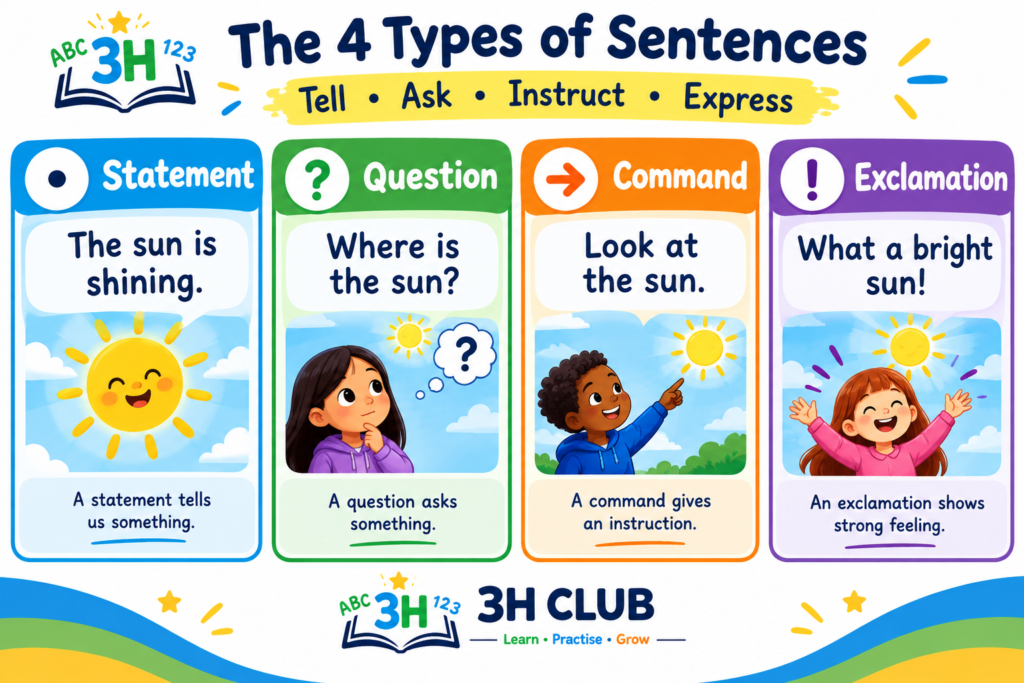
Identify the purpose first, then check the punctuation.
A question asks. A command instructs. A statement tells. An exclamation expresses a strong reaction.
Remember that a sentence ending in an exclamation mark is not automatically an exclamation. “Stop!” is a command because it tells someone what to do.
🔤 Keep Learning Grammar
Great work! You now know how the four types of sentences help us communicate.
You can build on these skills by learning how words and punctuation work together.
- Learn about nouns — discover words that name people, places, animals, things and ideas.
- Learn about verbs — explore action words and other verbs.
- Learn about adjectives — find out how describing words add detail.
- Learn about pronouns — discover words that can take the place of nouns.
- Visit 3HClub.org — continue your learning journey.
❓ Questions & Answers
What are the four types of sentences?
The four main types are statements, questions, commands and exclamations. Each has a different purpose: to tell, ask, instruct or express a strong reaction.
What is a statement?
A statement tells us something, such as a fact, an idea or an opinion.
Example: “The garden is full of flowers.”
Statements usually end with a full stop.
What is a question?
A question asks for information or invites someone to think about something.
Example: “Where did you put your bag?”
Questions end with a question mark.
What is a command?
A command tells someone to do something. It may give an instruction, make a request or offer advice.
Example: “Please close the gate.”
Commands usually end with a full stop, although an urgent command may end with an exclamation mark.
What is an exclamation?
An exclamation expresses a strong feeling or reaction, such as excitement, surprise or delight.
Example: “What a fantastic goal!”
Exclamations end with an exclamation mark.
What punctuation mark ends a question?
A question ends with a question mark (?). For example: “Are you ready?”
Can a command end with an exclamation mark?
Yes. An urgent or forceful command can end with an exclamation mark.
Example: “Look out!”
It remains a command because it tells someone what to do.
Is every sentence that ends with an exclamation mark an exclamation?
No. A statement or command can also end with an exclamation mark.
For example, “We won!” is a statement, while “Celebrate!” is a command. The sentence’s purpose helps you identify its type.
Why should I use different types of sentences in my writing?
Different sentence types help you communicate in different ways. Statements explain ideas, questions invite answers, commands give instructions and exclamations express strong reactions. Using them thoughtfully makes your writing clearer and more interesting.
Can one sentence be both a statement and an exclamation?
In everyday writing, a statement can express excitement and end with an exclamation mark, as in “We won!” In the traditional four-type grammar classification used in this lesson, it is still a statement because it tells us what happened. An exclamation, such as “What a wonderful victory!”, has a different grammatical purpose.
Well done! 🎉 You have learned the four types of sentences and how to use them to communicate more clearly.
Keep practising, keep asking questions and keep sharing your ideas. Every sentence you write is a chance to grow your skills!
3HClub.org — Learn • Practise • Grow