Parts of Speech for Kids
Learn How Words Work Together to Build Sentences
📚 🔤 ✏️ Have you ever wondered why some words name things, others describe them, and others tell us what happens?
Think about this sentence:
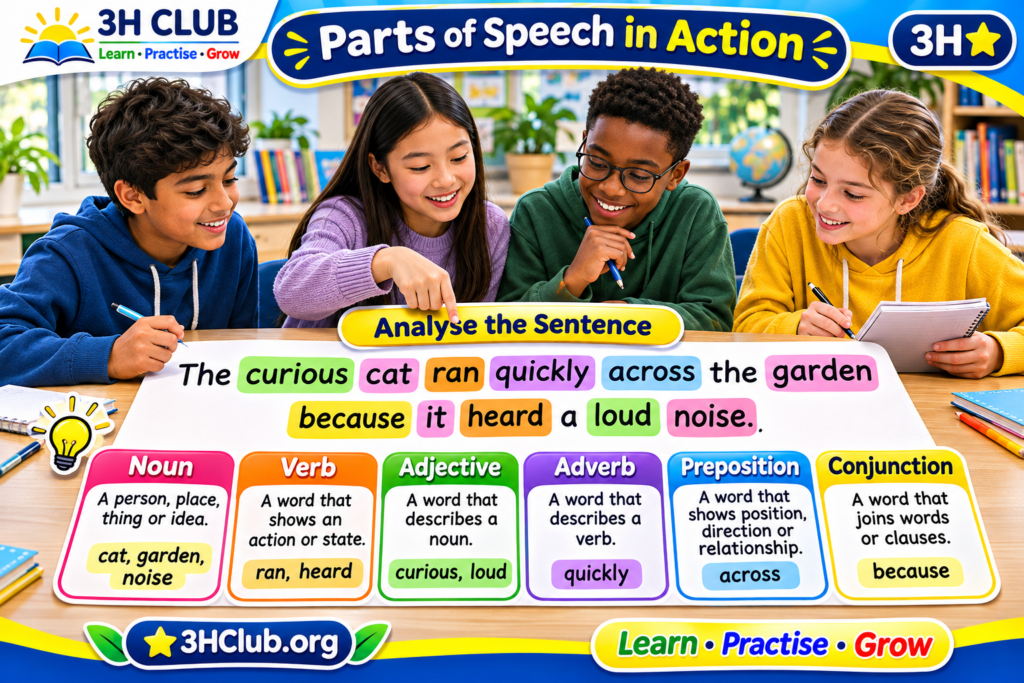
The curious fox quickly crossed the narrow bridge.
The word fox names an animal. Curious describes the fox. Crossed tells us what happened, and quickly tells us how the fox crossed the bridge.
Each word has a job to do!
These jobs are called parts of speech. Learning about them helps you understand how sentences work, choose better words and become a more confident reader and writer.
At 3HClub, you’ll explore parts of speech step by step, from recognizing nouns and verbs to understanding how different word types work together.
🔤 What Are Parts of Speech?
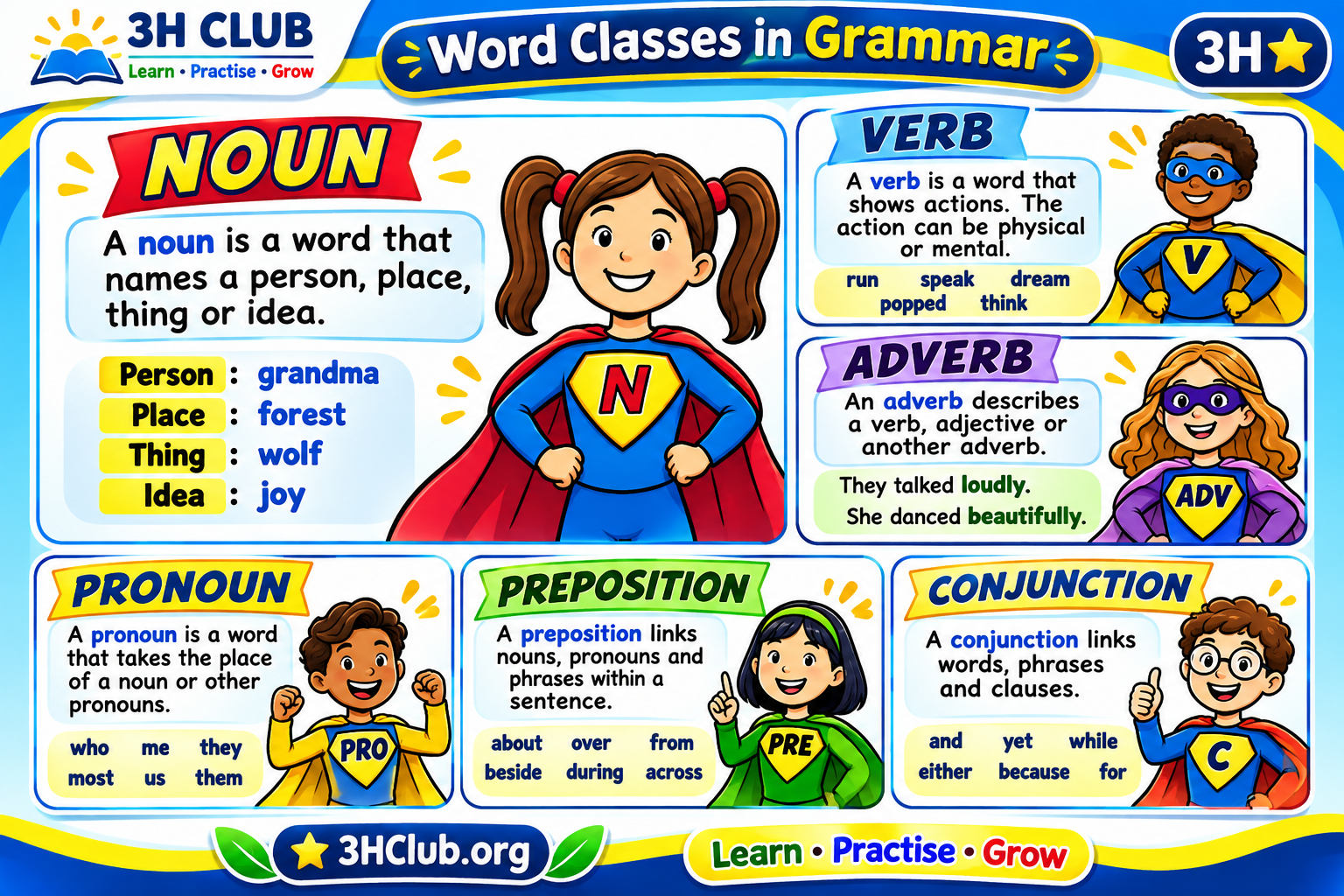
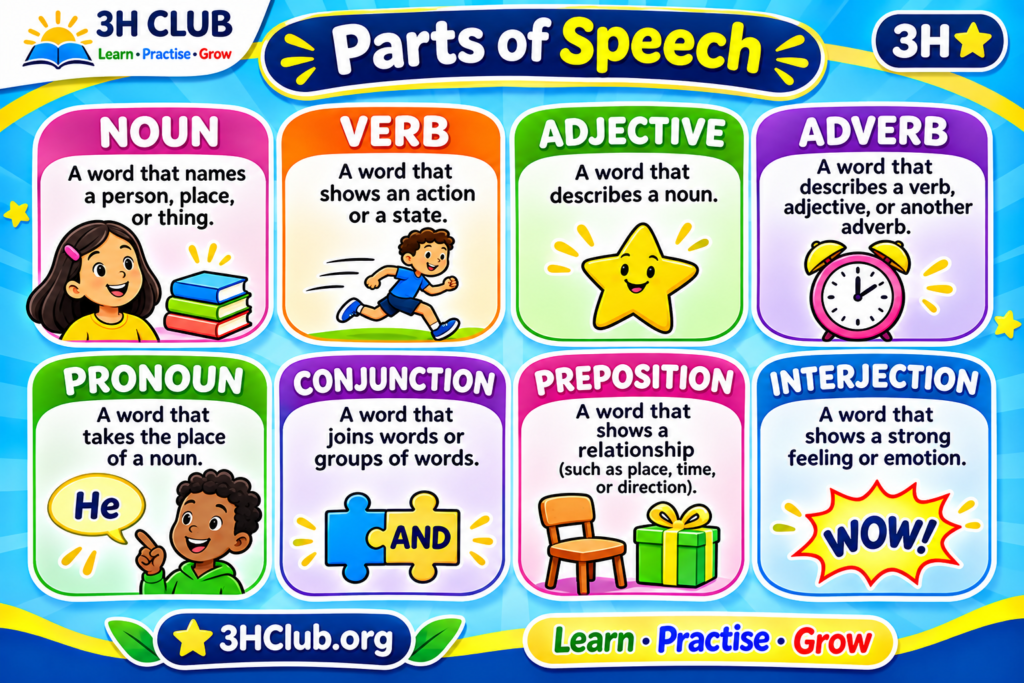
Parts of speech are groups of words classified by the jobs they do in sentences.
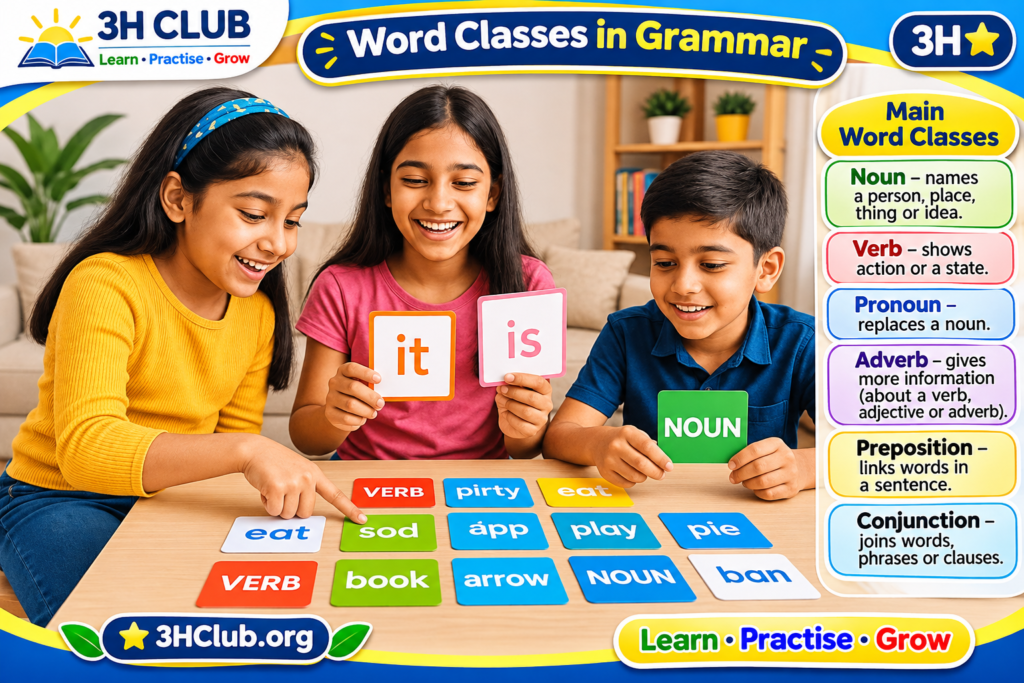
In English, eight traditional parts of speech are commonly taught:
- Nouns — name people, places, animals, things or ideas.
- Pronouns — take the place of nouns or noun phrases.
- Verbs — express actions, events or states.
- Adjectives — describe nouns and pronouns.
- Adverbs — give more information about actions, descriptions or other parts of a sentence.
- Prepositions — show relationships such as place, time or direction.
- Conjunctions — connect words, phrases or clauses.
- Interjections — express feelings or reactions.
You may also learn about articles and determiners, such as a, an, the, this and those. These help introduce or identify nouns. Some grammar systems classify these as a separate word class.
Let’s see how the eight traditional parts of speech work.
🧩 Parts of Speech at a Glance
| Part of speech | What it does | Example |
|---|---|---|
| Noun | Names something | The rabbit hopped. |
| Pronoun | Stands in for a noun or noun phrase | It hopped. |
| Verb | Shows an action or state | The rabbit hopped. |
| Adjective | Describes a noun or pronoun | The small rabbit hopped. |
| Adverb | Adds information about an action or description | The rabbit hopped quickly. |
| Preposition | Shows a relationship | The rabbit sat under the table. |
| Conjunction | Connects words or ideas | I like apples and pears. |
| Interjection | Expresses a reaction | Wow! That is amazing. |
Notice how each word contributes something different. Together, these word types help us express ideas clearly.
🔎 Jump To
- ⭐ Starters — Ages 6–7
- ⭐⭐ Builders — Ages 8–9
- ⭐⭐⭐ Champions — Ages 10–11
- 🧠 Big Parts of Speech Challenge
- 📌 Parts of Speech Checklist
- ❓ Frequently Asked Questions
⭐ Starters: Meet the Word Team!
Around ages 6–7
Words are like a team. Each word has a job, and the jobs work together to help us communicate.
Let’s begin with four important parts of speech: nouns, verbs, adjectives and pronouns.
🐱 1. Nouns — Naming Words
A noun names a person, place, animal, thing or idea.
Examples:
- Person: teacher
- Place: school
- Animal: cat
- Thing: pencil
- Idea: kindness
Read this sentence:
The cat sat on the mat.
The words cat and mat are nouns because they name things.
You can learn more in our Nouns for Kids lesson.
🏃 2. Verbs — Action and Being Words
A verb can tell us what someone or something does. Verbs can also tell us about a state or condition.
Examples:
- jump
- run
- sing
- write
- is
- are
Read this sentence:
The dog runs.
The word runs tells us what the dog does. It is a verb.
Now try this one:
The sky is blue.
The word is is a verb too. It helps describe the sky’s state.
Explore more examples in Verbs for Kids.
🎨 3. Adjectives — Describing Words
An adjective gives us more information about a noun or pronoun.
Examples:
- a red ball
- a happy child
- a tall tree
- a soft pillow
In the phrase a red ball, the word red tells us what the ball is like.
Adjectives help us imagine what we are reading about.
Visit Adjectives for Kids to learn more.
👧 4. Pronouns — Words That Stand In
A pronoun can take the place of a noun or noun phrase, helping us avoid repeating the same words.
For example:
Maya has a book. Maya reads the book.
That sounds repetitive, doesn’t it?
We can improve it:
Maya has a book. She reads it.
Here, she stands in for Maya, and it stands in for the book.
Other pronouns include I, you, he, we, they and them.
Find out more in Pronouns for Kids.
🧩 Put the Word Team Together
Look at this sentence:
The cheerful boy kicked the ball.
- boy — noun
- cheerful — adjective
- kicked — verb
- ball — noun
Each word has a different job. Together, they make a clear sentence.
🎯 Starters Activity: Find the Word Jobs
A. Choose the correct answer
1. Which word is a noun?
A. jump
B. rabbit
C. quickly
2. Which word is a verb?
A. sing
B. blue
C. chair
3. Which word is an adjective?
A. happy
B. run
C. pencil
4. Which word is a pronoun?
A. garden
B. she
C. swim
B. Find the word
5. In “The small bird sings,” which word is the adjective?
6. In “Tom runs,” which word is the verb?
7. In “Lily has a kite. She flies it,” which word stands in for Lily?
C. Your Turn
Complete these sentences with your own ideas:
- The ______ dog barked. (Add an adjective.)
- The children ______ outside. (Add a verb.)
- ______ is my friend. (Add a pronoun.)
- I can see a ______. (Add a noun.)
✅ Check Your Answers
- B — rabbit
- A — sing
- A — happy
- B — she
- small
- runs
- She
For the last four, many answers are possible. Check that each word does the job requested.
⭐ Starters Tip: Ask yourself: Is the word naming something, telling what happens, describing something or standing in for a name?
⭐⭐ Builders: Discover More Parts of Speech
Around ages 8–9
You already know that nouns name things, verbs express actions or states, adjectives describe, and pronouns can replace nouns. Now let’s meet four more useful parts of speech and explore how the word team works together.
🏃 1. Adverbs — Words That Add Information
An adverb can tell us more about a verb, an adjective or another adverb.
Adverbs often answer questions such as:
- How? — carefully, quickly, quietly
- When? — yesterday, soon, later
- Where? — here, there, outside
- How often? — always, often, sometimes
Examples:
- The girl spoke quietly. (How did she speak?)
- We will leave soon. (When will we leave?)
- The children played outside. (Where did they play?)
- He often reads before bed. (How often does he read?)
Many adverbs end in -ly, but not all do. Words such as fast, often, here and soon can also be adverbs.
Be careful: not every word ending in -ly is an adverb. For example, friendly is usually an adjective.
📍 2. Prepositions — Words That Show Relationships
A preposition often tells us where or when something happens, or shows direction.
Examples:
- The bag is under the desk.
- The book is on the table.
- We walked through the gate.
- I will visit you after lunch.
- The bird flew over the fence.
Prepositions help us understand how people, places, objects and events are related.
Try It
Imagine a toy car and a box.
- The car is inside the box.
- The car is beside the box.
- The car is behind the box.
The preposition changes the relationship between the car and the box.
🔗 3. Conjunctions — Connecting Words
A conjunction joins words, phrases or clauses.
Common conjunctions include:
- and — adds information
- but — shows a contrast
- or — offers a choice
- because — gives a reason
- so — can show a result
Examples:
- I like apples and bananas.
- I wanted to play, but it was raining.
- Would you like juice or water?
- We stayed inside because the storm was strong.
- I was tired, so I went to bed.
Conjunctions help connect ideas so your writing flows more smoothly.
😮 4. Interjections — Words That Express Reactions
An interjection is a word or short expression that shows a feeling or reaction.
Examples:
- Wow! That is a huge tree.
- Ouch! I stubbed my toe.
- Hurray! We won the game.
- Oh! I forgot my book.
Interjections often appear with an exclamation mark, but punctuation depends on the strength and purpose of the expression.
🧠 One Sentence, Many Jobs
Read this sentence:
Wow! The excited children quickly ran through the gate because the game had started.
Let’s investigate:
- Wow! — interjection
- children — noun
- excited — adjective
- quickly — adverb
- ran — verb
- through — preposition
- because — conjunction
- the — article or determiner
A sentence can contain several parts of speech working together.
🎯 Builders Activity: Word Detective
A. Identify the part of speech
1. The rabbit hopped quickly.
What part of speech is quickly?
2. The shoes are under the bed.
What part of speech is under?
3. I wanted to swim, but the pool was closed.
What part of speech is but?
4. Wow! Your painting is beautiful.
What part of speech is Wow!?
B. Choose the best word
5. The turtle moved ______.
A. slowly
B. green
C. chair
6. The pencil is ______ the book.
A. because
B. beside
C. happily
7. I wore a coat ______ it was cold.
A. because
B. under
C. wow
8. Would you like an apple ______ a banana?
A. quickly
B. or
C. behind
C. Explore a sentence
Read:
The cheerful girl carefully placed her bag beside the chair, and then she smiled.
Find:
9. One noun.
10. One adjective.
11. One adverb.
12. One preposition.
13. One conjunction.
14. One pronoun.
D. Your Turn
Write a sentence that includes:
- A noun
- A verb
- An adjective
- An adverb
- A conjunction
Underline each word and label its part of speech.
✅ Check Your Answers
- Adverb
- Preposition
- Conjunction
- Interjection
- A — slowly
- B — beside
- A — because
- B — or
- Possible answers: girl, bag, chair.
- cheerful
- carefully
- beside
- and
- she or her
For your own sentence, check that every chosen word fits its role.
⭐⭐ Builder Tip: Ask what a word is doing in its sentence. The job it performs is often the best clue to its part of speech.

⭐⭐⭐ Champions: Analyse How Words Work Together
Around ages 10–11
You now know the eight traditional parts of speech. The next step is to use them more carefully when reading and writing.
Remember that a word’s part of speech depends on how it is used. The same word can sometimes do different jobs in different sentences.
🔎 1. A Word’s Job Can Change
Look at the word play.
- We watched the play. (Play is a noun here.)
- The children play outside. (Play is a verb here.)
Now consider light:
- Turn on the light. (Light is a noun.)
- This is a light bag. (Light is an adjective.)
- Please light the candle. (Light is a verb.)
The spelling stays the same, but the word’s job changes.
This is why you should look at the whole sentence before deciding on a part of speech.
🧠 2. Adjectives and Adverbs Are Different
Adjectives usually describe nouns or pronouns. Adverbs often give more information about verbs, adjectives or other adverbs.
Compare:
- The careful driver stopped. (Careful describes the driver.)
- The driver stopped carefully. (Carefully tells us how the driver stopped.)
Another example:
- The puzzle was easy.
- The puzzle was surprisingly easy.
In the second sentence, surprisingly modifies the adjective easy.
Do not rely only on word endings. The word’s role in the sentence is more important than whether it ends in -ly.
🔗 3. Conjunctions Connect Different Kinds of Ideas
Conjunctions do more than join two words. They can connect clauses and show how ideas relate.
Coordinating conjunctions
Words such as and, but and or can connect ideas of equal grammatical importance.
- I wanted to ride my bike, but it started raining.
- We can read a book or play a board game.
- Sam packed the snacks, and Mia filled the water bottles.
Subordinating conjunctions
Words such as because, although, when and if can introduce a dependent clause.
- We stayed indoors because it was raining.
- Although she was tired, she finished her book.
- Call me when you arrive.
- If we leave early, we can catch the bus.
These words help explain reasons, contrasts, time and conditions.
📍 4. Prepositions and Prepositional Phrases
A preposition often begins a prepositional phrase. The phrase gives extra information about place, time, direction or another relationship.
Examples:
- under the table
- after the match
- towards the river
- with my friends
Read this sentence:
After lunch, the team walked towards the field with their coach.
- After lunch tells us when.
- Towards the field tells us the direction.
- With their coach tells us who accompanied them.
The prepositions are after, towards and with. The complete phrases provide the extra information.
🧱 5. Articles and Determiners
You may also meet words such as a, an, the, this, those, my and several.
These words help identify or give information about nouns.
Examples:
- The dog is sleeping.
- Those books belong to me.
- My brother likes football.
- Several children joined the club.
In many traditional school grammar lessons, a, an and the are called articles. Modern grammar often groups articles with determiners, which identify or quantify nouns.
For this age group, the important thing is to recognise how these words help us understand which person or thing is being discussed.
📝 6. Why Parts of Speech Matter in Writing
Understanding word jobs helps you make your writing more precise.
Compare:
The bird moved.
This sentence is clear, but it does not give us much detail.
Now try:
The tiny bird flew gracefully across the garden.
- bird — noun
- tiny — adjective
- flew — verb
- gracefully — adverb
- across — preposition
- the — article or determiner
- garden — noun
The second sentence gives the reader a clearer picture.
However, adding more words is not always better. Choose words that add useful information rather than filling a sentence with unnecessary details.
🕵️ 7. The Context Test
When you are unsure about a word, follow these steps:
- Read the entire sentence.
- Ask what the word contributes to the meaning.
- Check which word or words it relates to.
- Decide whether it names, describes, expresses an action or state, connects ideas, shows a relationship or performs another grammatical job.
- Reread the sentence to see whether your answer makes sense.
Example
The children raced home.
- children names people, so it is a noun.
- raced tells what they did, so it is a verb.
- home tells where they raced. In this sentence, home functions as an adverbial expression rather than a preposition.
That last example is a useful reminder: not every word describing a place is a preposition.
🎯 Champions Challenge: Grammar Investigator
A. Identify the part of speech
1. The bright moon appeared.
What part of speech is bright?
2. The athlete ran swiftly.
What part of speech is swiftly?
3. We stayed home because the road was flooded.
What part of speech is because?
4. The keys are inside the drawer.
What part of speech is inside in this sentence?
5. Hurray! Our team won.
What part of speech is Hurray!?
B. Same word, different job
Identify the part of speech of the bold word in each sentence.
6. We watched a show.
7. Please show me your drawing.
8. The fast train arrived.
9. The train moved fast.
C. Analyse the sentence
Read:
Although the weather was chilly, the enthusiastic hikers walked steadily along the winding path, and they reached the lake before sunset.
Find:
10. One conjunction that introduces a dependent clause.
11. One adjective describing the hikers.
12. One adverb describing how the hikers walked.
13. One preposition that shows a relationship or direction.
14. One pronoun.
15. Two nouns.
D. Improve the sentence
Rewrite this sentence to make it more descriptive:
The dog ran.
Include at least one adjective, one adverb and a prepositional phrase.
E. Explain Your Thinking
Why is it important to read the whole sentence before deciding what part of speech a word belongs to?
✅ Check Your Answers
- Adjective
- Adverb
- Conjunction
- Preposition
- Interjection
- Noun
- Verb
- Adjective
- Adverb
- Although
- enthusiastic
- steadily
- along
- they
- Possible answers: weather, hikers, path, lake, sunset.
Example for Question D: “The excited dog ran quickly across the grassy field.”
- excited — adjective
- quickly — adverb
- across the grassy field — prepositional phrase
- across — preposition
Question E: A word can perform different jobs in different sentences. Reading the whole sentence helps you understand how the word is being used.
⭐⭐⭐ Champion Tip: Grammar is not just about memorising labels. It is about noticing how words work together to create meaning.
🧠 Big Parts of Speech Challenge
Ready to test your knowledge? Try the questions first, then check the answers.
⭐ Starters
1. Which word is a noun?
A. quickly
B. teacher
C. jump
2. Which word is a verb?
A. sing
B. yellow
C. chair
3. In “The happy dog barked,” which word is the adjective?
⭐⭐ Builders
4. What part of speech is quietly in “She spoke quietly”?
5. What part of speech is under in “The cat is under the bed”?
6. Which word connects the ideas in “I was tired, but I finished my work”?
⭐⭐⭐ Champions
7. What part of speech is light in “Please light the candle”?
8. What part of speech is light in “This bag is light”?
9. Find the conjunction, adjective and adverb in this sentence:
“Although the tired team worked carefully, they finished the difficult puzzle.”
10. Write a sentence containing at least four different parts of speech. Label each one.
✅ Challenge Answers
- B — teacher
- A — sing
- happy
- Adverb
- Preposition
- but
- Verb
- Adjective
- Although — conjunction; tired or difficult — adjective; carefully — adverb.
- Answers will vary. Example: “The cheerful child smiled warmly.” The — article/determiner; cheerful — adjective; child — noun; smiled — verb; warmly — adverb.
📌 Parts of Speech Checklist
Before you finish, check that you can:
- 🐱 Recognise nouns that name people, places, things and ideas.
- 🏃 Identify verbs that express actions, events or states.
- 🎨 Find adjectives that describe nouns or pronouns.
- 👧 Recognise pronouns that take the place of nouns or noun phrases.
- 💨 Identify adverbs that add information about actions or descriptions.
- 📍 Find prepositions that show relationships such as place, time and direction.
- 🔗 Recognise conjunctions that connect words, phrases or clauses.
- 😮 Identify interjections that express reactions.
- 🧠 Use the whole sentence to work out a word’s job.
- ✏️ Choose words that make your own writing clear and interesting.
Remember: Parts of speech help us understand how words work together. The more you practise, the easier it becomes to build clear, meaningful sentences.
❓ Parts of Speech — Frequently Asked Questions
What are parts of speech?
Parts of speech are groups of words classified according to the jobs they do in sentences. They help explain how words fit together to create meaning.
What are the eight traditional parts of speech?
The eight traditional parts of speech are nouns, pronouns, verbs, adjectives, adverbs, prepositions, conjunctions and interjections.
What is a noun?
A noun names a person, place, animal, thing or idea. Examples include teacher, school, dog, pencil and kindness.
What is a verb?
A verb expresses an action, event or state. Examples include run, think, grow, is and have.
What is the difference between an adjective and an adverb?
An adjective usually describes a noun or pronoun, as in “a careful driver”. An adverb often gives more information about a verb, adjective or another adverb, as in “drives carefully”.
What is a pronoun?
A pronoun can take the place of a noun or noun phrase. In “Mia has a book. She reads it,” she stands in for Mia, and it stands in for the book.
What is a preposition?
A preposition shows a relationship, often involving place, time or direction. Examples include under, beside, after, through and towards.
What is a conjunction?
A conjunction connects words, phrases or clauses. Examples include and, but, or, because and although.
What is an interjection?
An interjection expresses a feeling or reaction. Examples include Wow!, Ouch! and Hurray!
Can a word belong to different parts of speech?
Yes. A word can have different grammatical jobs in different sentences. For example, play is a noun in “We watched a play” and a verb in “We play outside”.
Are articles a part of speech?
Articles are words such as a, an and the. In many traditional school lessons, they are taught as a separate category. In modern grammar, they are usually grouped with determiners.
Why should I learn parts of speech?
Understanding parts of speech helps you read more carefully, build sentences, choose precise words and improve your writing. It also makes it easier to learn other grammar topics, such as clauses, punctuation and verb tenses.
Keep exploring words, building sentences and growing your skills. Learn • Practice • Grow with 3HClub!