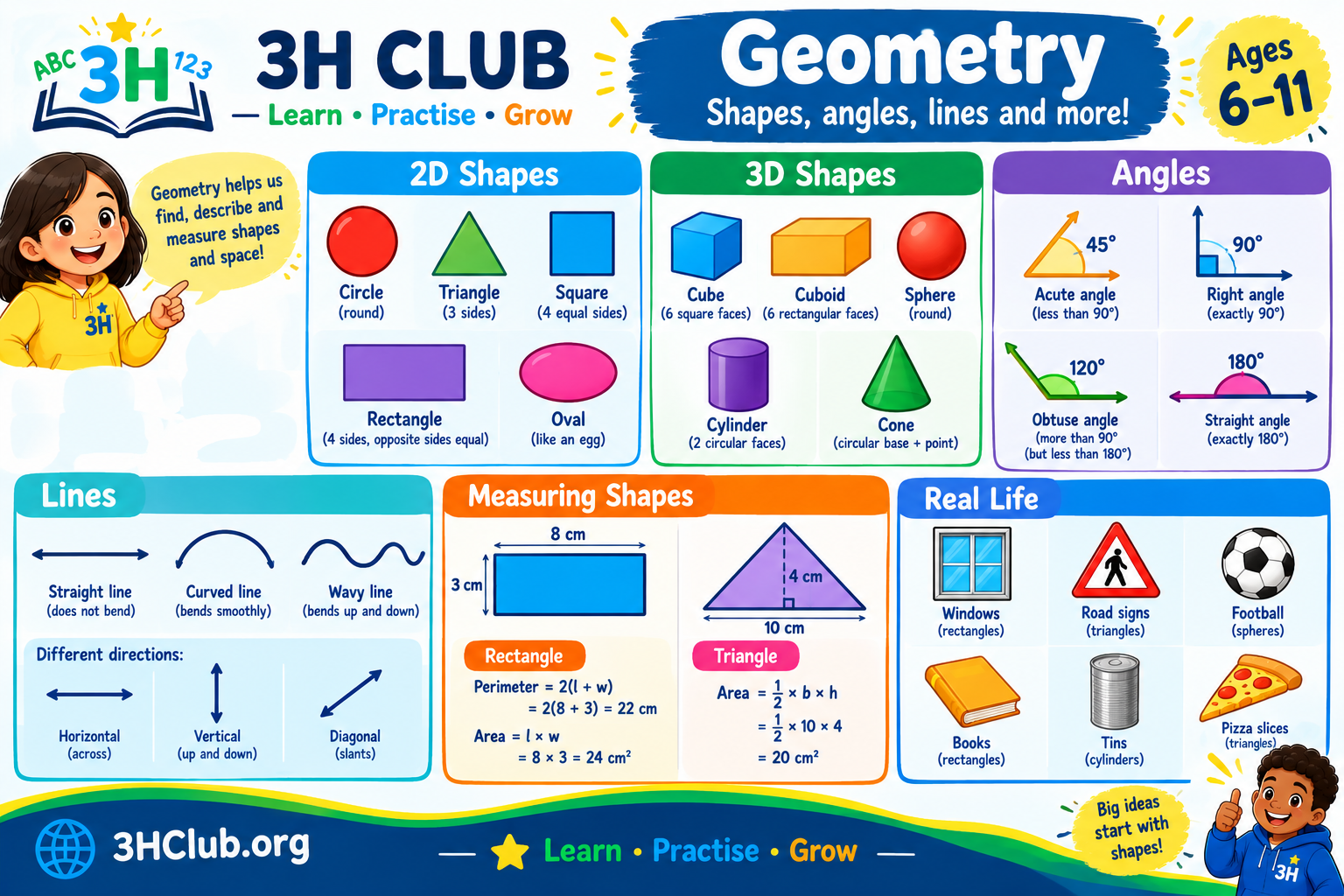
Geometry for Kids
Shapes, Angles, Lines and More
Learn • Practise • Grow with 3HClub.org
Have you ever noticed how many shapes you see every day? Windows are often rectangles, road signs can be triangles, and footballs have patterns made from shapes. Even the buildings around you are designed using ideas from geometry!
Geometry is the part of maths that helps us understand shapes, lines, angles, sizes, positions and space. It helps you describe the world around you, solve puzzles and work out measurements.
In this guide, you will explore geometry step by step, from naming simple shapes to calculating the area of a rectangle and understanding angles. There are three learning levels, so you can build your skills as you go.
Let’s get started!
⭐ Starters — Ages 6–7: Discover Shapes
Geometry begins with noticing shapes and describing what makes them different. Look around your home, classroom or playground. How many shapes can you spot?
What is a shape?
A shape is the outline or form of something. In geometry, we learn about flat shapes, such as circles and squares, and solid shapes, such as cubes and spheres.
Flat shapes are called 2D shapes because they have two dimensions: length and width.
Here are some shapes you will often meet.
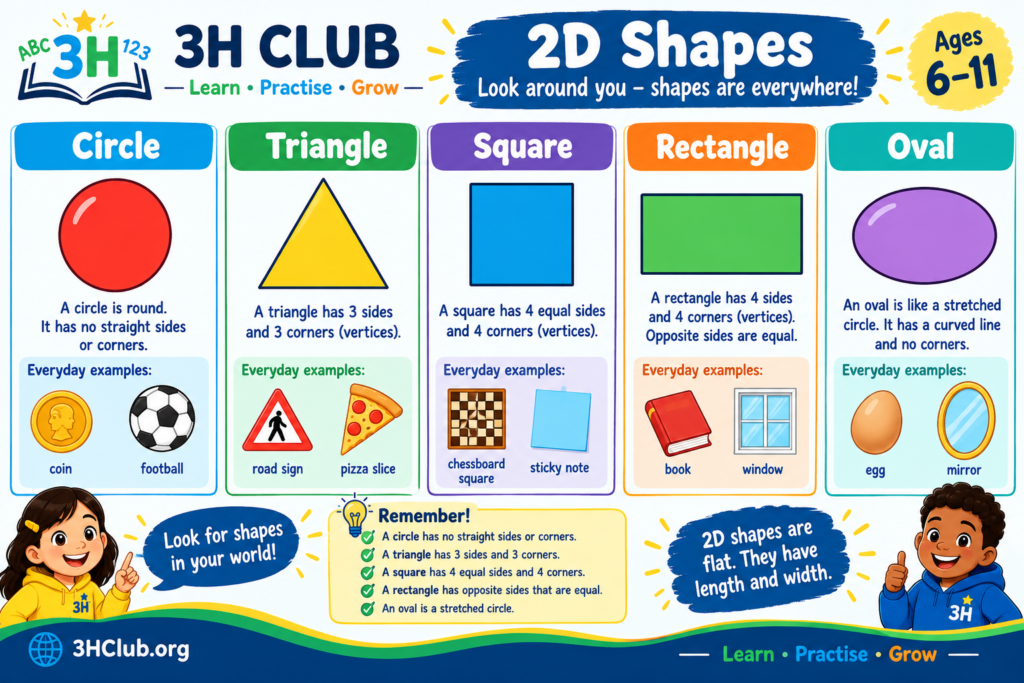
Meet the 2D shapes
| SAHPE | HOW TO RECOGNIZE IT | EXAMPLE |
| Circle | Round, with no straight sides or corners. | A coin |
| Triangle | 3 straight sides and
3 corners |
A triangular road sign |
| Square | 4 equal sides and 4 square corners | A chessboard square |
| Rectangle | 4 sides and 4 square corners; opposite sides are equal | A book cover
|
| Oval | Rounded and stretched, like an egg | An oval mirror |
A corner where two straight sides meet is called a vertex. The plural is vertices.
Try tracing a square in the air with your finger. Count its sides as you go. Now try a triangle. Can you feel the difference?
What are 3D shapes?
Some shapes are not flat. They are solid objects that have length, width and height. These are called 3D shapes.
- Cube: Has 6 square faces, like a dice.
- Cuboid: Has 6 rectangular faces, like a cereal box.
- Sphere: A round solid shape, like a ball.
- Cylinder: Has 2 circular flat faces and one curved surface, like a tin can.
- Cone: Has a circular base and a point, like an ice-cream cone.
A flat shape is like a drawing on paper. A solid shape is more like an object you can hold.
Lines: Straight, curved and wavy
Lines are important in geometry because they help us make and describe shapes.
- Straight line: Does not bend.
- Curved line: Bends smoothly.
- Wavy line: Bends up and down.
A straight line can also be horizontal, vertical or diagonal.
- Horizontal: Goes across, like the horizon.
- Vertical: Goes up and down, like a standing pole.
- Diagonal: Slants, like a slide.
What are angles?
An angle is made when two lines or sides meet at a point.
You can imagine an angle as the opening between the hands of a clock.
At this level, start by spotting small and large openings. Later, you will learn how to measure angles in degrees.
⭐ Starters practice
Try these questions before checking the answers.
- How many sides does a triangle have?
- Which shape has four equal sides and four square corners?
- Is a football more like a sphere or a cube?
- What 3D shape is a typical tin can?
- Is a line that goes straight up and down horizontal or vertical?
- How many vertices does a rectangle have?
Check your answers
- 3 sides.
- A square.
- A sphere.
- A cylinder.
- Vertical.
- 4 vertices.
Great work! You have started to recognize the shapes and features that make up geometry.
⭐⭐ Builders — Ages 8–9: Explore Sides, Angles and Perimeter
You already know some common shapes. Now let’s look more closely at their properties and learn how to measure the space around them.
Polygons: Shapes with straight sides
A polygon is a flat, closed shape made from straight line segments.
Triangles, squares, rectangles and pentagons are all polygons. A circle is not a polygon because it has a curved boundary rather than straight sides.
Polygons have names based on the number of sides they have.
| Polygon | Number of sides |
|---|---|
| Triangle | 3 |
| Quadrilateral | 4 |
| Pentagon | 5 |
| Hexagon | 6 |
| Heptagon | 7 |
| Octagon | 8 |
A quadrilateral is any four-sided polygon. Squares and rectangles are special types of quadrilateral.
Understanding angles
Angles are measured in degrees, written using the symbol °.
There are three important types of angle to learn first.
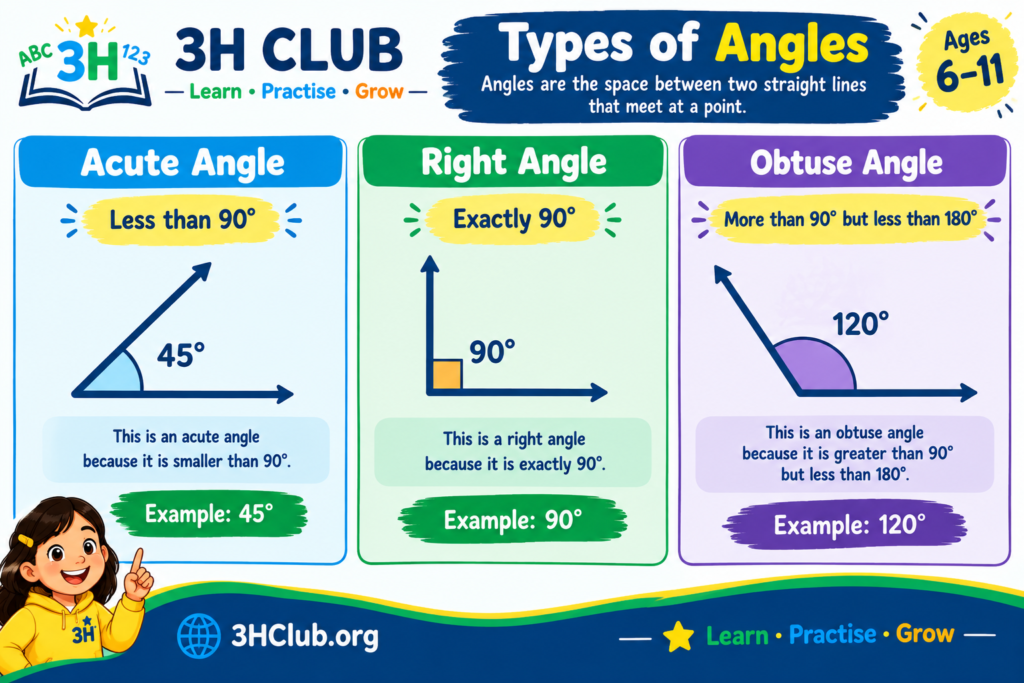
- Acute angle: Less than 90°, such as 45°.
- Right angle: Exactly 90°, like the corner of a square.
- Obtuse angle: More than 90° but less than 180°, such as 120°.
- Straight angle: Exactly 180°, forming a straight line.
A full turn measures 360°.
You can use a protractor to measure an angle. Place its center on the angle’s vertex, line up one arm with the zero line, and read where the other arm crosses the scale.
Parallel and perpendicular lines
Lines can have different relationships.
Parallel lines stay the same distance apart and never meet, even if they continue in both directions. The opposite sides of a rectangle are parallel.
Perpendicular lines meet at a right angle of 90°. The two sides that meet at a corner of a square are perpendicular.
These ideas help us describe shapes, maps, buildings and patterns.
What is perimeter?
The perimeter is the total distance around the outside of a flat shape.
Imagine walking all the way around a rectangular playground. The distance you walk around its edge is its perimeter.
To find the perimeter, add the lengths of all the sides.
Example 1: A rectangle
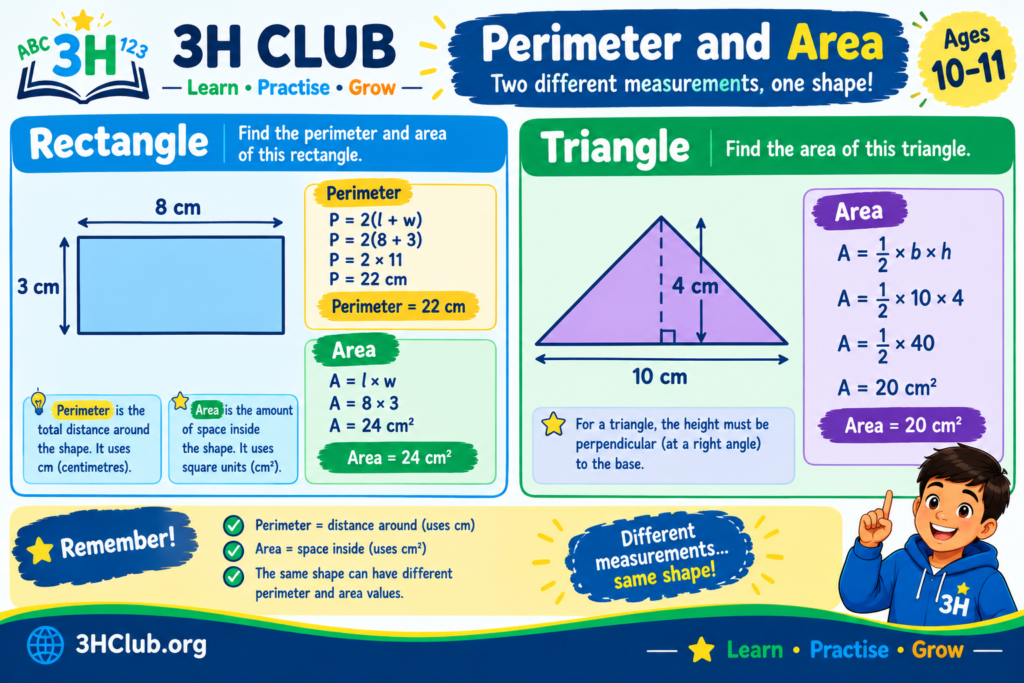
A rectangle has a length of 8 cm and a width of 3 cm.
Its four sides are 8 cm, 3 cm, 8 cm and 3 cm.
[ P = 8 + 3 + 8 + 3 = 22cm]
The perimeter is 22 cm.
For a rectangle, you can also use:
[ P = 2 (length + width) ]
So:
[ P = 2 x ( 8 + 3 ) = 22cm]
Example 2: A square
Each side of a square is 5 cm long.
[ P = 5 + 5 + 5 + 5 = 20cm ]
The perimeter is 20 cm.
For a square, multiply one side by 4.
[ P = 4 x (side length) ]
⭐⭐ Builders practice
- What is the name of a polygon with 6 sides?
- Is an angle of 35° acute, right or obtuse?
- What type of angle measures exactly 90°?
- A triangle has sides of 4 cm, 5 cm and 6 cm. What is its perimeter?
- A square has sides of 7 cm. Find its perimeter.
- A rectangle is 9 cm long and 4 cm wide. Find its perimeter.
- What is the relationship between two perpendicular lines?
- Is a circle a polygon? Explain why or why not.
Check your answers
- Hexagon.
- Acute.
- Right angle.
- ( 4 + 5 + 6 = 15cm).
- ( 4 x 7 = 28cm).
- ( 9 + 4 + 9 + 4 = 26cm).
- They meet at a 90° angle.
- No. A circle has a curved boundary rather than straight sides.
Keep going! You can now describe angles, recognize different polygons and calculate perimeter.
⭐⭐⭐ Champions — Ages 10–11: Area, Coordinates and More
Now it is time to use geometry to solve more challenging problems. You will explore area, properties of triangles, symmetry, coordinates and the difference between perimeter and area.
What is area?
The area is the amount of flat surface covered by a shape. Imagine covering a tabletop with square tiles. The number of square tiles needed helps you understand its area.
Area is measured in square units, such as square centimeters (cm²) or square meters (m²).
Finding the area of a rectangle
To find the area of a rectangle, multiply its length by its width.
[ A = length x width]
Example: A rectangle is 8 cm long and 3 cm wide.
[ A = 8 x 3 = 24 cm²]
Its area is 24 cm².
Notice the difference:
- Perimeter measures the distance around the shape.
- Area measures the surface inside the shape.
For the same rectangle, the perimeter is 22 cm and the area is 24 cm². The units are different because these measurements describe different things.
Finding the area of a triangle
A triangle’s area is half the area of a rectangle with the same base and perpendicular height.
[ A = base x height ÷ 2]
Example: A triangle has a base of 10 cm and a perpendicular height of 4 cm.
[ A=10 x 4 = 40 ÷ 2 = 20 cm² ]
Its area is 20 cm².
Remember that the height must be measured at a right angle to the base. A sloping side is not necessarily the height.
Triangles and their properties
Triangles can be grouped by their side lengths or angles.
By side length:
- Equilateral triangle: All three sides are equal.
- Isosceles triangle: At least two sides are equal.
- Scalene triangle: All three sides have different lengths.
By angle:
- Acute triangle: All three angles are less than 90°.
- Right-angled triangle: One angle is exactly 90°.
- Obtuse triangle: One angle is greater than 90°.
The three interior angles of any triangle always add up to 180°.
Example: Two angles of a triangle are 55° and 65°. What is the third angle?
The missing angle is 60°.
Symmetry: Finding matching halves
A shape has line symmetry if a line can divide it into two matching halves that are mirror images of each other.
That line is called a line of symmetry.
A square has 4 lines of symmetry. A non-square rectangle has 2. A circle has infinitely many lines of symmetry because any line through its centre divides it into two matching halves.
Try drawing a line through a shape and imagining folding it along that line. If the two halves match exactly, the line is a line of symmetry.
Coordinates: Finding a position
Coordinates help you describe the exact position of a point on a grid.
A point is written as an ordered pair:
The first number tells you how far to move horizontally along the x-axis. The second tells you how far to move vertically along the y-axis.
For example, the point ((3,2)) means:
- Start at the origin, ((0,0)).
- Move 3 units to the right.
- Move 2 units up.
You have reached ((3,2)).
The order matters! The point ((2,3)) is in a different place.
Explore more with our Coordinates for Kids guide.
Circles: A few important parts
Circles have their own useful vocabulary.
- Centre: The point in the middle of a circle.
- Radius: A straight line from the center to the edge.
- Diameter: A straight line across the circle through its centre.
- Circumference: The distance around the circle.
The diameter is twice the radius.
[d=2r]
If a circle has a radius of 4 cm, its diameter is:
[d = 2 times 4 = 8 cm]
You may later learn formulas for calculating a circle’s area and circumference.
⭐⭐⭐ Champions practice
- A rectangle is 12 cm long and 5 cm wide. Find its perimeter.
- Find the area of that same rectangle.
- A triangle has a base of 8 cm and a perpendicular height of 6 cm. Find its area.
- Two angles in a triangle are 48° and 72°. Find the third angle.
- How many lines of symmetry does a square have?
- What point do you reach if you move 4 units right and 3 units up from the origin?
- A circle has a radius of 7 cm. What is its diameter?
- Explain the difference between area and perimeter.
Check your answers
- ( 12 + 5 + 12 + 5 = 34cm).
- ( 12 x 5 = 60 cm²).
- ( 8 x 6 = 32 ÷ 2 = 16cm²).
- (180° – (48° + 72°) = 180° – 120° = 60°).
- 4 lines of symmetry.
- ((4,3).
- (2 x 7 = 14cm).
- Perimeter is the total distance around a shape; area is the amount of surface inside it.
Excellent work! You have explored several important geometry skills, from measuring shapes to solving problems with formulas.
Geometry Quick Reference
| Geometry idea | What it means | Example |
|---|---|---|
| 2D shape | A flat shape with length and width | Square |
| 3D shape | A solid shape with length, width and height | Cube |
| Polygon | A closed flat shape with straight sides | Pentagon |
| Acute angle | An angle less than 90° | 45° |
| Right angle | An angle of 90° | Corner of a square |
| Obtuse angle | An angle between 90° and 180° | 120° |
| Perimeter | Distance around a shape | Rectangle: (2l+2w) |
| Area of a rectangle | Space inside a rectangle | (l\times w) |
| Area of a triangle | Half the base multiplied by the perpendicular height | (\frac12 bh) |
| Radius | Centre to the edge of a circle | 4 cm |
| Diameter | Across the circle through the center | Twice the radius |
Frequently Asked Questions About Geometry
What is geometry in maths?
Geometry is the study of shapes, lines, angles, sizes, positions and space. It helps us describe objects and understand how they fit together.
What is the difference between 2D and 3D shapes?
A 2D shape is flat and has length and width. A 3D shape is solid and has length, width and height. A square is 2D, while a cube is 3D.
What is the difference between perimeter and area?
Perimeter measures the total distance around a shape. Area measures the surface inside it. Perimeter uses units such as centimeters, while area uses square units such as square centimeters.
What is a polygon?
A polygon is a closed, flat shape made from straight sides. Triangles, quadrilaterals, pentagons and hexagons are examples.
How do you find the area of a rectangle?
Multiply its length by its width. For example, a rectangle measuring 6 cm by 4 cm has an area of (6\times4=24\text{ cm}^2).
How many degrees are in a triangle?
The three interior angles of a triangle always add up to 180°.
What is symmetry?
A shape has line symmetry when a line divides it into two matching mirror-image halves.
Where can I see geometry in everyday life?
Geometry is all around you! Look for shapes in buildings, tiles, signs, furniture, sports equipment, maps and artwork.
Remember: Every shape has features worth discovering, and every problem is an opportunity to learn something new.
Learn • Practice • Grow with 3HClub.org!