Mastery of Time
What Are the Building Blocks of Language?
Think of language like a construction set. You can use small pieces to create something bigger and more meaningful.
- Sounds and letters help us recognize and write words.
- Words name things, describe them, show actions and express ideas.
- Phrases bring words together to share a little more information.
- Sentences communicate complete thoughts.
- Punctuation helps organize writing and show how sentences should be read.
- Meaning and context help us understand what someone is trying to say.
Each building block has a purpose. Let’s discover how they fit together!
⭐ Starters — Ages 6–7
1. Letters and Sounds: Where Words Begin
Before you can read and write words, you need to recognise letters and the sounds they can represent.
The English alphabet has 26 letters. Letters can be written as capital letters or lowercase letters.
For example:
- A and a
- B and b
- M and m
Letters represent sounds in many words. When you put letters together, you can spell words such as cat, sun, dog and fish.
Try saying the word cat slowly. You can hear three sounds: /k/, /a/ and /t/. The letters c, a and t represent those sounds in this word.
Sounds and letters are important building blocks because they help us read, spell and recognize words.
2. Words: Small Pieces with Big Jobs
A word can name something, describe something or tell us what happens.
Here are three useful types of words to begin with.
Nouns name people, places, animals or things.
Examples: girl, school, dog, book
Verbs tell us about actions or states.
Examples: run, jump, read, is
Adjectives describe nouns.
Examples: happy, blue, tiny, soft
Look at this sentence:
The happy dog runs.
- dog is a noun. It names an animal.
- happy is an adjective. It describes the dog.
- runs is a verb. It tells us what the dog does.
See how the words work together? Each one adds something useful to the sentence.
You can learn more about nouns for kids, verbs for kids and adjectives for kids.
3. Phrases: Words That Belong Together
A phrase is a group of words that work together as a unit.
For example:
- the little bird
- a bright yellow kite
- under the table
These groups of words give us information, but they do not always express a complete thought on their own.
Compare these examples:
A little bird — We know what we are talking about, but what is the bird doing?
A little bird sings. — Now we have a complete thought.
Phrases help us add details and make our messages more interesting.
4. Sentences: Complete Thoughts
A sentence puts words together to communicate a thought.
For example:
- The sun is shining.
- My brother likes music.
- We played outside.
A sentence usually begins with a capital letter and ends with suitable punctuation, such as a full stop, question mark or exclamation mark.
Try reading these two examples:
The rabbit.
The rabbit hopped into the garden.
The first example names something but does not tell us a complete thought. The second tells us what the rabbit did.
A sentence often includes a subject — who or what the sentence is about — and a verb that tells us what happens or what the subject is like.
5. Punctuation: Helpful Reading Signs
Punctuation marks help readers understand writing. They show where sentences end and when a writer is asking a question or expressing strong feeling.
Meet three useful punctuation marks:
- Full stop (.) — ends a statement: I like apples.
- Question mark (?) — ends a question: Do you like apples?
- Exclamation mark (!) — can show strong feeling or excitement: What a huge apple!
Punctuation might look small, but it makes a big difference to meaning.
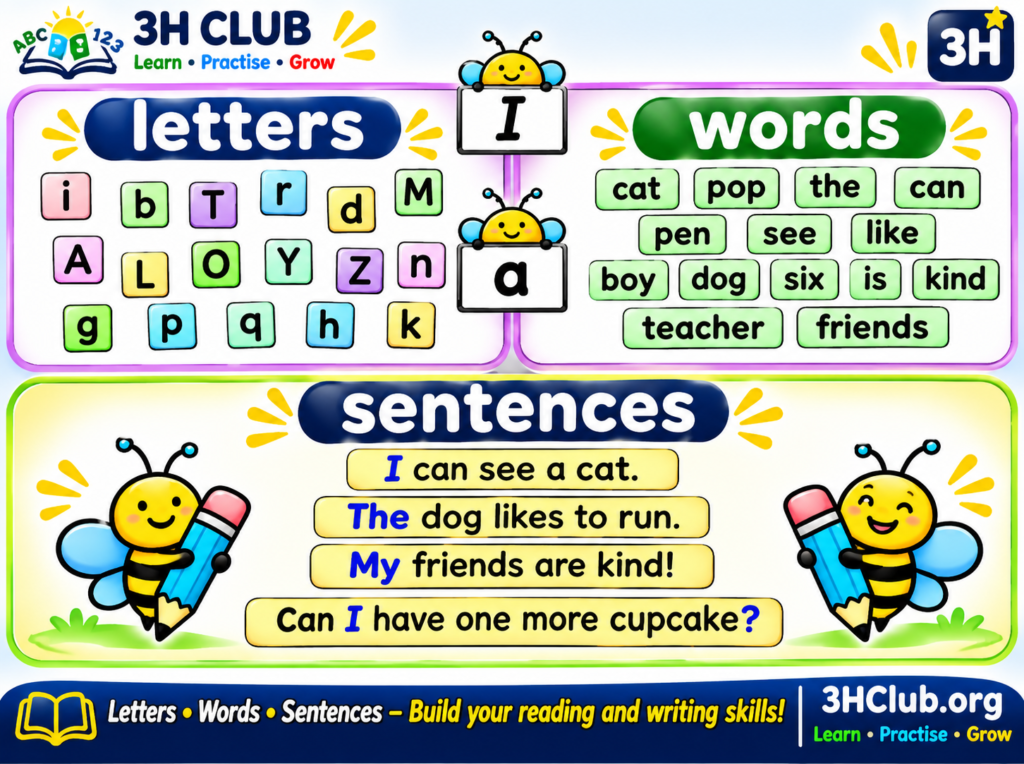
⭐ Starters Activity — Build a Sentence
Try these quick challenges.
A. Choose the noun.
Which word names an animal?
- fluffy
- rabbit
- hops
B. Choose the verb.
Which word tells us what someone does?
- dance
- yellow
- pencil
C. Add the correct punctuation.
Choose a full stop, question mark or exclamation mark.
- Where is my bag__
- I found my bag__
- What a lovely bag__
D. Build a sentence.
Put these words in the correct order:
park / the / children / play / in
Answers: A: 2, rabbit. B: 1, dance. C: 1, ?, 2, ., 3, ! D: The children play in the park.
⭐⭐ Builders — Ages 8–9
You already know that words form sentences. Now it’s time to look more closely at how different words work together to make language clear, detailed and interesting.
1. Parts of Speech: Different Words, Different Jobs
Words belong to different groups according to the jobs they do. These groups are called parts of speech.
Here are some important ones.
| Part of speech | What it does | Example |
|---|---|---|
| Noun | Names a person, place, animal, thing or idea | teacher |
| Verb | Shows an action or state | explains |
| Adjective | Describes a noun | helpful |
| Adverb | Adds information about a verb, adjective or another adverb | clearly |
| Pronoun | Can take the place of a noun or noun phrase | she, they, it |
| Preposition | Shows relationships such as place, time or direction | under, before, through |
| Conjunction | Connects words, phrases or clauses | and, but, because |
Consider this sentence:
The helpful teacher explains the lesson clearly.
- teacher is a noun.
- helpful is an adjective describing the teacher.
- explains is a verb.
- clearly is an adverb telling us how the teacher explains.
A word’s job depends on how it is used. For example, play can be a verb in “We play outside” and a noun in “The school play was funny”.
Learning about parts of speech helps you understand how sentences are built and choose words more carefully when you write.
Explore more about pronouns and how they help us avoid repeating the same nouns.
2. Phrases Add Details
A phrase is a group of words that works together, but it does not necessarily express a complete thought.
Compare these examples:
- the enormous tree
- beside the river
- after lunch
Each phrase gives us information, but none expresses a complete thought by itself.
Now look at the sentence:
The enormous tree stood beside the river after lunch.
The phrases add details about the tree, its location and the time.
Phrases help you expand simple sentences without having to start a new sentence for every detail.
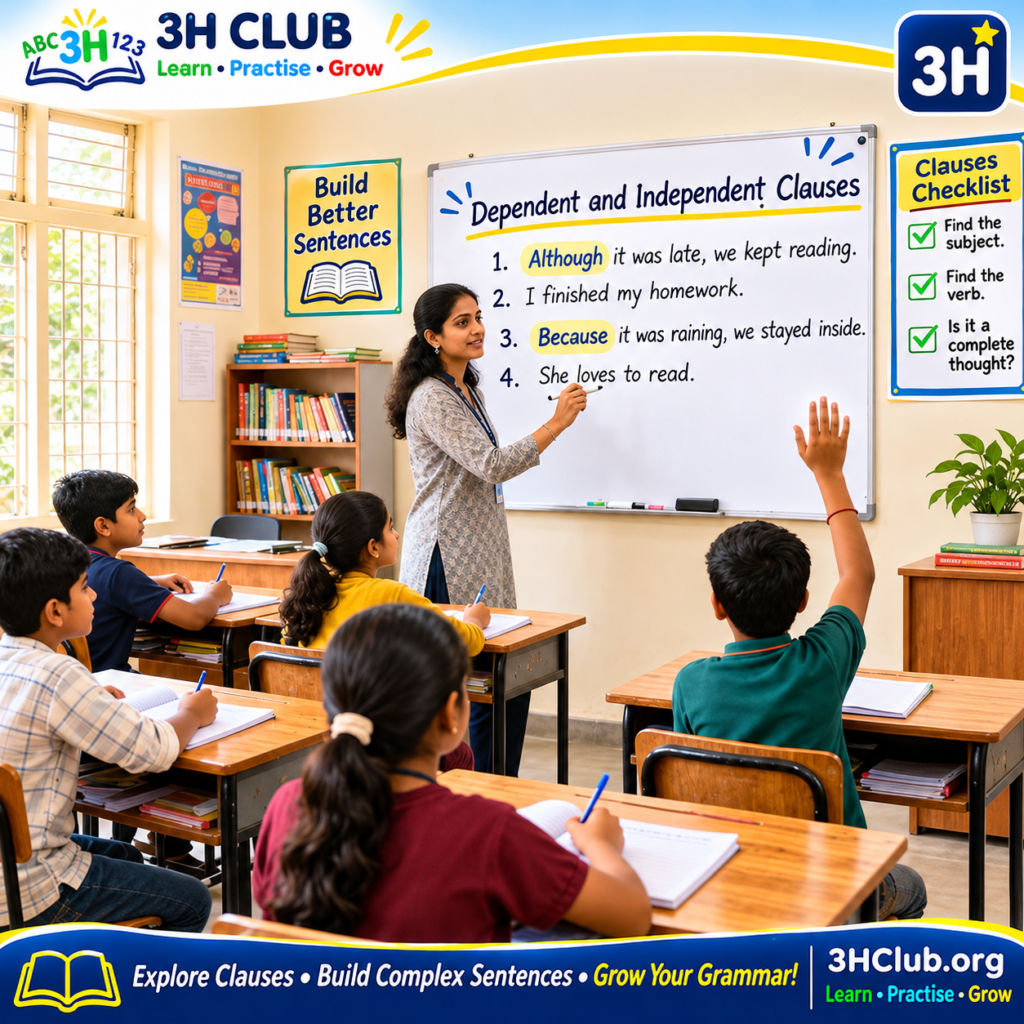
3. Clauses: Groups of Words with a Subject and a Verb
A clause is a group of words that contains a subject and a verb.
There are two useful types to learn about.
An independent clause expresses a complete thought.
Example: The children laughed.
A dependent clause contains a subject and a verb but does not express a complete thought on its own.
Example: because the joke was funny
Put them together:
The children laughed because the joke was funny.
The independent clause tells us what happened. The dependent clause explains why.
Words such as because, when, if and although can introduce dependent clauses.
Clauses help you explain reasons, describe events and connect ideas. You can learn more about clauses when you explore sentence structure in greater detail.
4. Sentences Need Structure
A well-built sentence places words in an order that makes the meaning clear.
Compare these examples:
The puppy chased the ball.
The ball chased the puppy.
Both sentences contain the same main words, but changing their order changes the meaning.
In many English statements, the subject comes before the verb, followed by other information.
- Subject: The puppy
- Verb: chased
- Other information: the ball
This is a common sentence pattern, although English uses other patterns for questions, commands and different kinds of sentences.
Word order matters because it helps readers understand who did what.
5. Conjunctions Connect Ideas
Conjunctions help us join words, phrases and clauses.
And adds information:
I packed a notebook and a pencil.
But shows contrast:
The path was steep, but we kept walking.
Because gives a reason:
We went inside because it started raining.
Using conjunctions can help you connect ideas instead of writing lots of short, separate sentences.
⭐⭐ Builders Activity — Explore the Building Blocks
A. Identify the parts of speech.
In the sentence below, find the noun, verb, adjective and adverb.
The curious fox moved quietly.
B. Spot the phrase.
Which group of words is a phrase?
- the old wooden bridge
- the bridge collapsed
- the bridge was old
C. Identify the clause.
Is the bold section independent or dependent?
We stayed indoors because the storm was strong.
D. Choose the conjunction.
Complete the sentence:
I wanted to go outside, ___ it was raining.
Choose: but / under / quickly
E. Improve the sentence.
Add a phrase to give this sentence more detail:
The bird sang.
Answers:
A: Noun — fox; verb — moved; adjective — curious; adverb — quietly.
B: 1, the old wooden bridge.
C: Dependent clause — because the storm was strong.
D: but.
E: Answers will vary. For example: The little bird sang in the tree.
⭐⭐⭐ Champions — Ages 10–11
Now you’re ready to explore how the building blocks fit together in more complex writing. Understanding language structure helps you make your meaning precise, vary your sentences and express ideas with confidence.
1. From Sounds to Meaning: A Language-Building Chain
Language can be understood as a series of connected levels.
Sounds and letters → words → phrases and clauses → sentences → paragraphs → whole texts
Each level helps build the next.
- Sounds and letters help us recognize and spell words.
- Words carry meaning and have different grammatical jobs.
- Phrases group words together.
- Clauses organize subjects and verbs into units of meaning.
- Sentences express statements, questions, commands and other thoughts.
- Paragraphs group related sentences.
- Texts bring paragraphs and other language features together to communicate a larger message.
This is a useful way to understand written English. Real communication also depends on speaking, listening, context, tone and the choices people make when they use language.
2. Grammar: How Language Fits Together
Grammar describes the patterns and rules that help words work together.
Consider these sentences:
The explorer discovered a cave.
A cave discovered the explorer.
The words are almost the same, but their order changes the meaning.
Grammar helps us understand relationships between words, including who performs an action and what the action affects.
It also helps us build sentences that fit the situation. For example, a question often uses a different word order from a statement:
- Statement: You are ready.
- Question: Are you ready?
Grammar is not simply about avoiding mistakes. It gives you tools for communicating ideas accurately and effectively.
3. Sentence Types and Their Purposes
Writers choose sentence structures according to what they want to communicate.
Statement: gives information.
The museum closes at five.
Question: asks for information.
What time does the museum close?
Command: tells someone to do something or gives an instruction.
Please return your ticket.
Exclamation: expresses strong feeling or emotion.
What an incredible exhibition!
Punctuation helps show the purpose of a sentence, but it is not the only clue. Word order, wording and context matter too.
For example, a command often begins with a verb: Open the window. A question often begins with a question word or an auxiliary verb: Where are you going? or Have you finished?
Understanding these patterns helps you choose the right structure for your audience and purpose.
4. Simple, Compound and Complex Sentences
Writers can combine clauses in different ways to create variety and show how ideas relate to one another.
Simple sentences
A simple sentence contains one independent clause.
The rain stopped.
It can still include extra details:
The heavy rain stopped suddenly in the afternoon.
Compound sentences
A compound sentence joins independent clauses, often with a coordinating conjunction such as and, but or so.
The rain stopped, and the children went outside.
Each clause can stand as a complete thought.
Complex sentences
A complex sentence contains an independent clause and at least one dependent clause.
The children went outside after the rain stopped.
Here, The children went outside is the independent clause. After the rain stopped is the dependent clause.
Using different sentence structures helps writing flow and allows you to show time, reasons, contrast and other relationships between ideas.
5. Punctuation Makes Meaning Clear
Punctuation helps readers follow the structure of a sentence and understand how ideas connect.
Compare:
Let’s eat, Grandma!
Let’s eat Grandma!
The comma in the first sentence shows that the speaker is talking to Grandma. Without the comma, the sentence can suggest a very different meaning!
Other punctuation marks have important jobs:
- Comma (,): separates items in a list and can separate parts of a sentence.
- Apostrophe (’): can show possession or missing letters in a contraction.
- Quotation marks (‘ ’ or “ ”): can mark the exact words someone says or quotes.
- Colon (:): can introduce a list or explanation.
- Semicolon (;): can connect closely related independent clauses or separate complex list items.
Different writing styles and regions may follow slightly different conventions, so follow the style expected for your task.
6. Context: Choosing the Right Words
Language is more than grammar. The situation, audience and purpose can change the words and sentence structures you choose.
Imagine asking a friend to close a window.
You might say:
Close the window, please.
In a more formal situation, you might say:
Would you mind closing the window, please?
Both communicate a similar request, but they sound different.
When you choose language, consider:
- Audience: Who will read or hear your message?
- Purpose: Are you explaining, persuading, entertaining or asking?
- Tone: Should your message sound friendly, serious, formal or excited?
- Clarity: Will your audience understand what you mean?
Strong communicators choose language that fits the situation.
⭐⭐⭐ Champions Activity — Language Detective
Read the short passage:
On Saturday, Maya visited the library because she wanted to find a book about space. She searched the science shelves, but the book she wanted was already borrowed. “I’ll try again next week,” she said.
A. Find the parts of speech.
Identify one example of each:
- A noun
- A verb
- An adjective
- A pronoun
- A conjunction
B. Explore the clauses.
In the sentence Maya visited the library because she wanted to find a book about space, identify:
- The independent clause
- The dependent clause
C. Identify the sentence structure.
Is this sentence simple, compound or complex?
She searched the science shelves, but the book she wanted was already borrowed.
D. Explain the punctuation.
Why are quotation marks used around I’ll try again next week?
E. Think about audience and purpose.
Imagine Maya is writing a formal email to the librarian to ask when the book will be returned. Write one polite sentence she could use.
Answers:
A: Possible answers include noun — library; verb — visited; adjective — science in science shelves is functioning as a noun modifier in that phrase, so another clear adjective from a revised example is preferable; pronoun — she; conjunction — because or but. For a straightforward adjective example in the passage, wanted is a verb, not an adjective, so choose borrowed only if you are analyzing its use as a participle in context. This question can also be used to discuss how word roles depend on context.
B: Independent clause — Maya visited the library. Dependent clause — because she wanted to find a book about space.
C: Compound sentence: it joins two independent clauses with but. The second clause contains the embedded relative clause she wanted, which describes the book.
D: They show the exact words Maya said.
E: Example: Could you please tell me when the book about space is expected to be returned?
Put the Building Blocks Together
You have explored how sounds, letters, words, phrases, clauses, sentences, punctuation and context work together.
When you read, try noticing how a writer builds sentences and connects ideas. When you write, experiment with precise words, varied sentence structures and punctuation that helps your reader.
You do not need to master every building block at once. Each new skill gives you another way to express your ideas clearly.
Keep reading, keep writing and keep growing with 3HClub!
Frequently Asked Questions
What are the building blocks of language?
They are the parts that work together to help us communicate, including sounds, letters, words, phrases, clauses, sentences, punctuation and meaning.
What is the difference between a word and a phrase?
A word is a single unit of language, such as tree. A phrase is a group of words that work together, such as the tall tree. A phrase does not necessarily express a complete thought.
What is the difference between a phrase and a clause?
A phrase is a group of words that works as a unit. A clause contains a subject and a verb. Some clauses express a complete thought, while others depend on another clause to complete their meaning.
Why is grammar important?
Grammar helps us organize words and sentences so that our meaning is clear. It also gives us choices for expressing ideas in different ways.
How can I improve my language skills?
Read different kinds of texts, learn new words, practice writing sentences, check your punctuation and notice how other writers communicate. Try explaining what you learn in your own words.