Open Wide, Close Tight
🗣️ Vowels & Consonants for Kids
A Simple Guide with Examples and Fun Practice
🔤 🅰️ 🐝 📚 ✏️ Discover how vowels and consonants help us read, spell and build words!
Look at the words around you. You might see cat, school, rainbow or friend.
Every word is made from letters, and each letter has a part to play. Some letters are vowels, while others are consonants. Learning the difference can help you sound out new words, spot spelling patterns and become a more confident reader and writer.
Ready to explore the alphabet? Let’s get started!
🔤 What Are Vowels and Consonants?
The English alphabet has 26 letters. These letters are divided into two main groups: vowels and consonants.
🅰️ Vowels
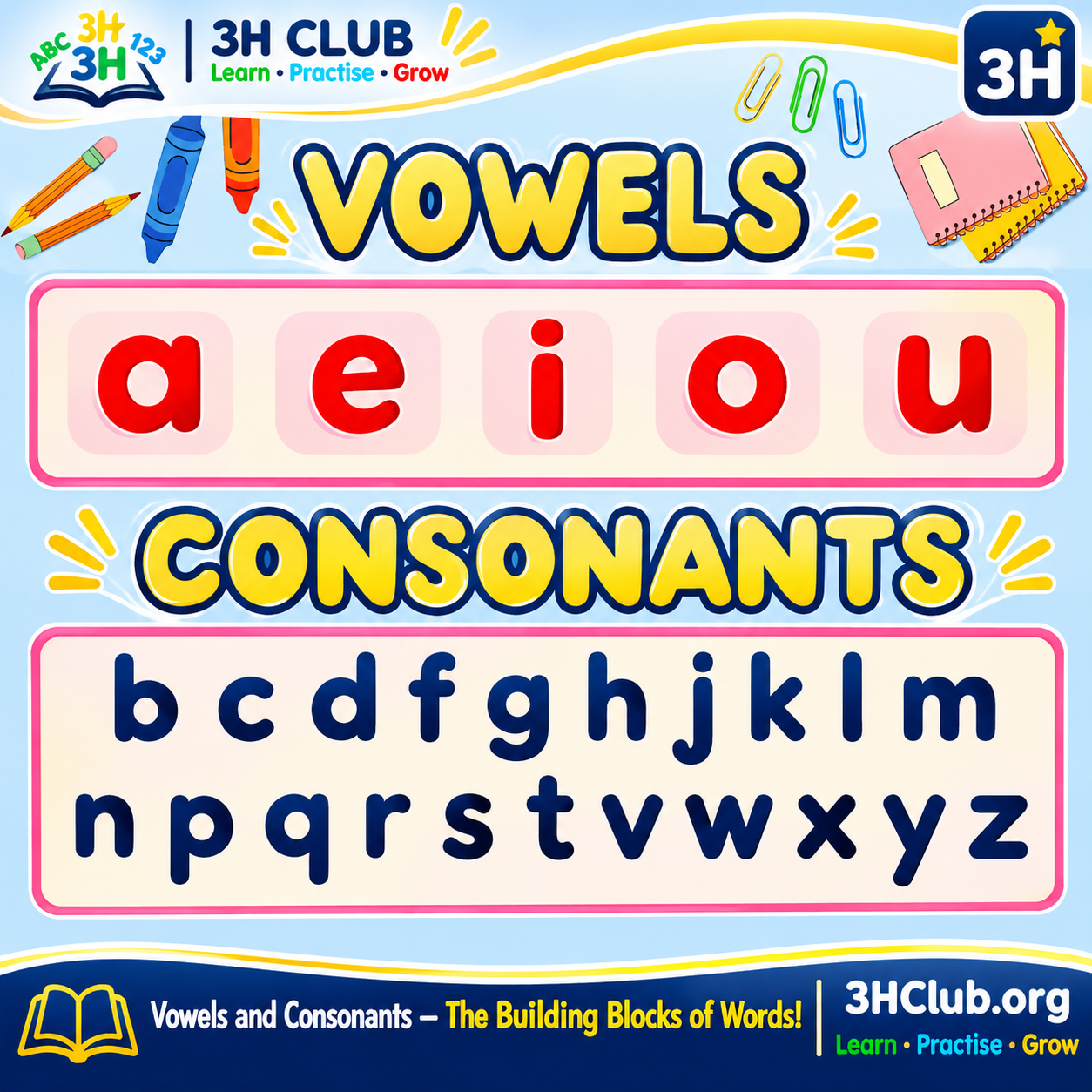
The five main vowel letters are:
A • E • I • O • U
You can remember them by saying:
A, E, I, O, U — the vowels are waiting for you!
Here are some examples:
- A — apple
- E — egg
- I — insect
- O — octopus
- U — umbrella
The letter Y can sometimes act as a vowel too, as in my, gym and happy.
🐝 Consonants
The other 21 letters of the alphabet are usually classed as consonants.
They include:
B • C • D • F • G • H • J • K • L • M • N • P • Q • R • S • T • V • W • X • Y • Z
Examples include:
- B — ball
- C — cat
- M — moon
- S — sun
- T — tiger
Consonants help words take shape. When we speak, consonant sounds are often made by closing or narrowing parts of the mouth, while vowel sounds are usually made with a more open mouth.
💡 Quick Answer
A vowel is one of the letters A, E, I, O or U. The letter Y can sometimes work as a vowel.
A consonant is one of the other alphabet letters when it is being used as a consonant.
Look at the word sun:
- S = consonant
- U = vowel
- N = consonant
The word sun has one vowel letter and two consonant letters.
👀 Try This
Look at the word map.
Can you find the vowel?
That’s right — A is the vowel. The letters M and P are consonants.
🔎 Jump To
- ⭐ Starters — Ages 6–7
- ⭐⭐ Builders — Ages 8–9
- ⭐⭐⭐ Champions — Ages 10–11
- 🧠 Big Vowels and Consonants Challenge
- 📌 Vowels and Consonants Checklist
- ❓ Questions and Answers
⭐ Starters: Let’s Find the Vowels!
Around ages 6–7
You already know that letters help us write words. Now let’s learn how to spot vowels and consonants.
🅰️ Meet the Five Vowels
Say the vowel letters aloud:
A • E • I • O • U
Each vowel can make different sounds in different words. For now, let’s begin with a familiar example for each one.
| Vowel | Example word |
|---|---|
| A | apple |
| E | egg |
| I | igloo |
| O | octopus |
| U | umbrella |
The vowel letter is shown at the beginning of each word. Can you say each word and listen to its first sound?
🐝 Meet the Consonants
Consonants are the other main group of letters.
Here are five to practise:
| Letter | Word | Find the consonant |
|---|---|---|
| B | ball | B |
| C | cat | C |
| D | dog | D |
| F | fish | F |
| M | moon | M |
Try saying each word slowly. Listen to the sounds you hear at the beginning.
🔍 Can You Spot the Vowel?
Look at these words:
- cat — the vowel is A
- bed — the vowel is E
- pig — the vowel is I
- fox — the vowel is O
- cup — the vowel is U
Each word has one vowel letter. The other letters are consonants.
Remember, we are looking at letters, not counting every sound we can hear. Sometimes two letters work together to represent one sound.
🎯 Starters Activity: Vowel or Consonant?
1. Which letter is a vowel?
A. B
B. A
C. T
2. Which word begins with a consonant?
A. apple
B. egg
C. sun
3. Find the vowel in dog.
A. D
B. O
C. G
4. Which group contains only vowel letters?
A. A, E, I, O, U
B. B, C, D, F, G
C. A, B, C, D, E
5. Is M a vowel or a consonant?
6. Find the vowel in each word:
- hat
- pen
- sit
- pot
- bus
✏️ Your Turn
Write one word that begins with each vowel:
- A: __________
- E: __________
- I: __________
- O: __________
- U: __________
Now write three words that begin with consonants.
✅ Check Your Answers
- B — A
- C — sun
- B — O
- A — A, E, I, O, U
- M is a consonant.
- hat — A; pen — E; sit — I; pot — O; bus — U.
Your own words may be different. That’s fine, as long as they begin with the correct vowel or consonant!
⭐ Starters Tip: When you are unsure, say the word slowly and look carefully at its letters.
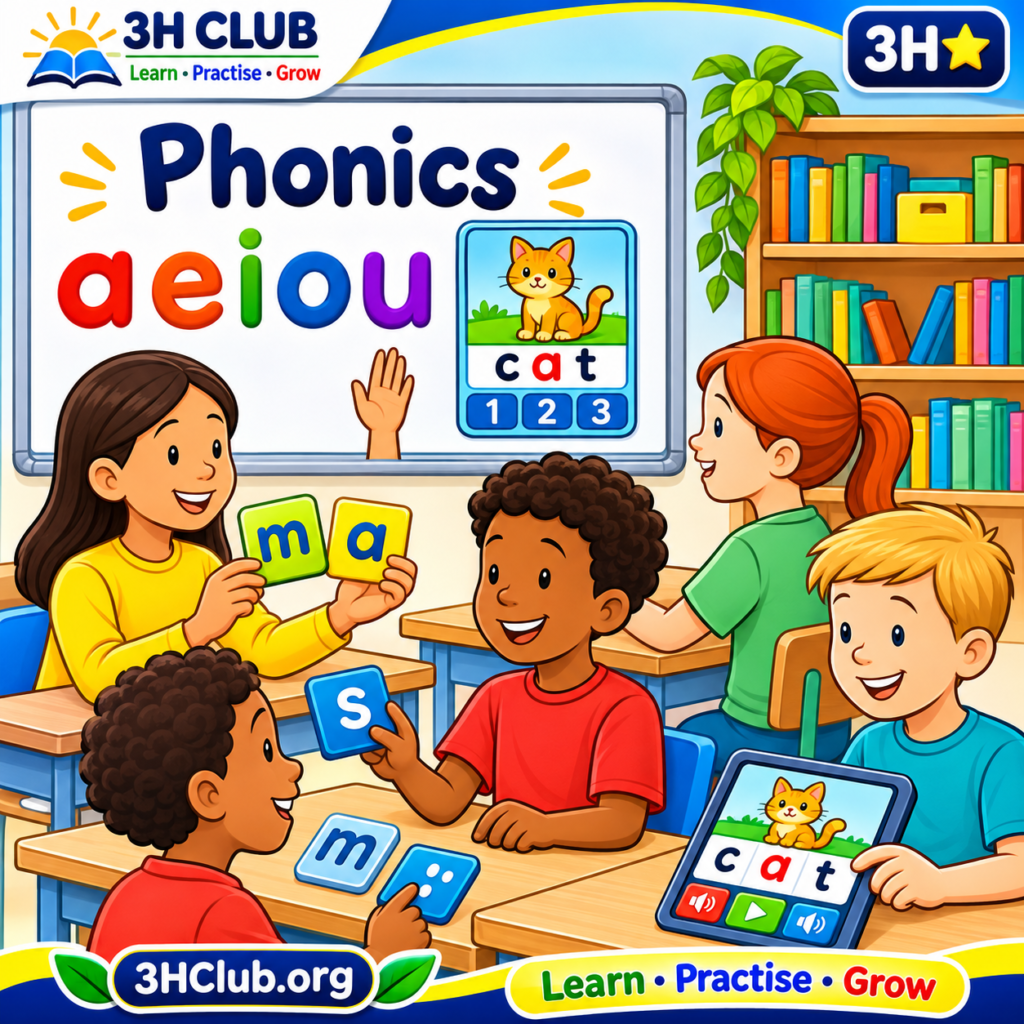
⭐⭐ Builders: Discover How Vowels and Consonants Work
Around ages 8–9
You now know the five main vowel letters and can identify consonants. Next, let’s look more closely at vowel sounds, consonant patterns and the way letters work together.
🔊 Vowel Letters Can Make Different Sounds
A vowel letter does not always make the same sound. Listen carefully to these examples.
Short vowel sounds
- A in cat
- E in bed
- I in sit
- O in hot
- U in cup
These are often called short vowel sounds.
Long vowel sounds
A long vowel sound often sounds like the name of the vowel letter.
- A in cake
- E in these
- I in bike
- O in home
- U in cube
These are useful patterns to learn, but English spelling has exceptions. The same vowel letter can sound different in different words.
💡 Compare the Words
| Short vowel | Long vowel |
|---|---|
| cap | cape |
| pet | Pete |
| kit | kite |
| hop | hope |
| cub | cube |
Notice how the final e changes the vowel sound in many of these pairs. It is often called a silent e because it is written but not pronounced as a separate sound.
For example:
- cap has a short A sound.
- cape has a long A sound.
- The final E helps change the vowel sound.
This is a common spelling pattern, although not every word ending in E follows it.
🧩 Vowel Teams: When Letters Work Together
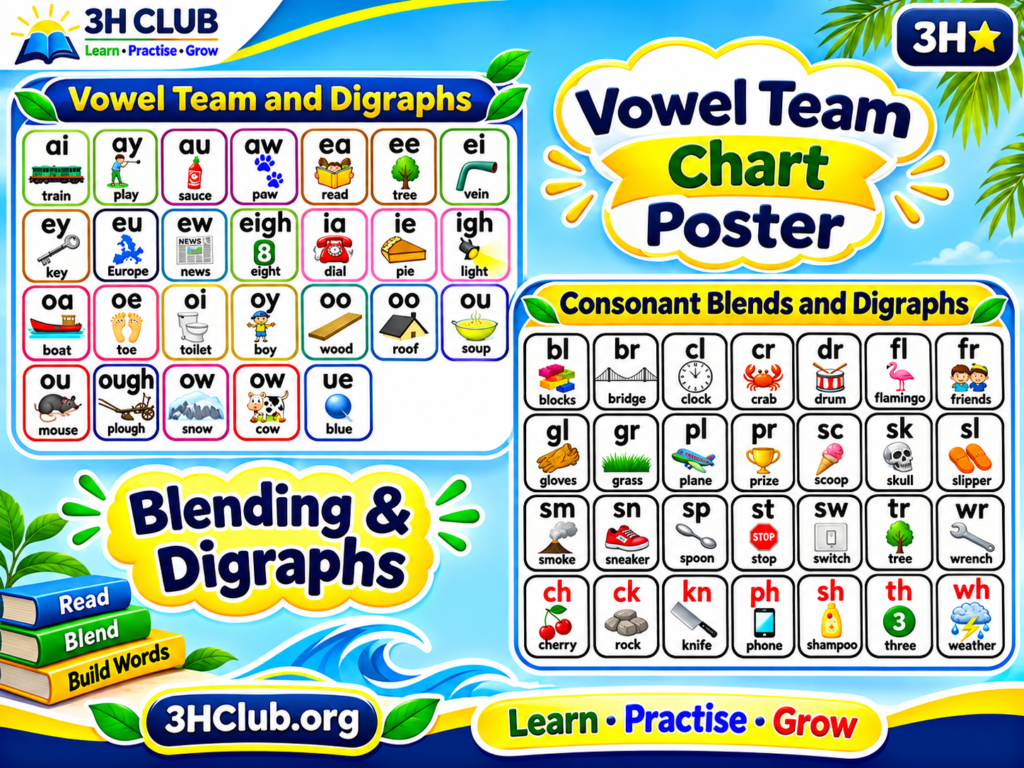
Sometimes two vowel letters work together to represent a vowel sound. These combinations are often called vowel teams.
Examples include:
- ai in rain
- ee in tree
- oa in boat
- ay in play
- ea in team
Look at the word rain. It contains the vowel letters A and I together. They work as a team to represent the main vowel sound in the word.
But be careful: the same letter combinations can sound different in other words. For example, ea sounds different in team and bread.
English spelling is full of patterns worth noticing!
🐝 Consonants Can Work Together Too
Two consonant letters can sit beside each other in a word. Sometimes you can hear both sounds clearly.
Consonant blends
In a consonant blend, two or more consonant sounds are next to each other, and you can still hear each sound.
Examples:
- bl in black
- st in star
- gr in green
- str in string
Try saying star slowly. You can hear the S and T sounds at the beginning.
Consonant digraphs
A consonant digraph is a pair of letters that represents one consonant sound.
Examples:
- sh in ship
- ch in chair
- th in thumb
- ph in phone
Compare:
- st in stop: you can hear two consonant sounds.
- sh in shop: the two letters work together to represent one consonant sound.
That is the main difference between a blend and a digraph.
🔤 What About the Letter Y?
The letter Y can work as either a consonant or a vowel, depending on the word.
- Y is a consonant in yes and yellow.
- Y acts as a vowel in gym, my and happy.
This is one reason it is useful to think about how a letter is being used in a particular word, rather than relying only on a memorised list.
🎯 Builders Activity: Explore the Patterns
1. Find the short vowel sound
Which word has a short A sound?
A. cake
B. cap
C. rain
2. Find the long I sound
A. sit
B. fish
C. bike
3. Which word contains a vowel team?
A. rain
B. dog
C. cup
4. Blend or digraph?
Is st in stop a consonant blend or a consonant digraph?
5. Blend or digraph?
Is sh in shop a consonant blend or a consonant digraph?
6. Is Y a vowel or consonant in yellow?
7. Is Y a vowel or consonant in gym?
8. Complete the word with a vowel team
- r__n (the weather)
- tr__ (a tall plant)
- b__t (a way to travel on water)
9. Find the vowel letters
Write the vowel letters in each word:
- train
- sheep
- home
10. Explain the difference
In your own words, explain the difference between a consonant blend and a consonant digraph.
✅ Check Your Answers
- B — cap
- C — bike
- A — rain
- Consonant blend: you can hear both the S and T sounds.
- Consonant digraph: SH represents one consonant sound.
- Y is a consonant in yellow.
- Y acts as a vowel in gym.
- rain, tree, boat.
- train — A and I; sheep — E and E; home — O and the final E. The final E is a vowel letter even though it is silent in this word.
- A blend keeps the separate consonant sounds audible; a digraph uses two letters to represent one sound.
⭐⭐ Builder Tip: When you see two letters together, ask yourself: Can I hear both sounds, or do the letters work together to represent one sound?
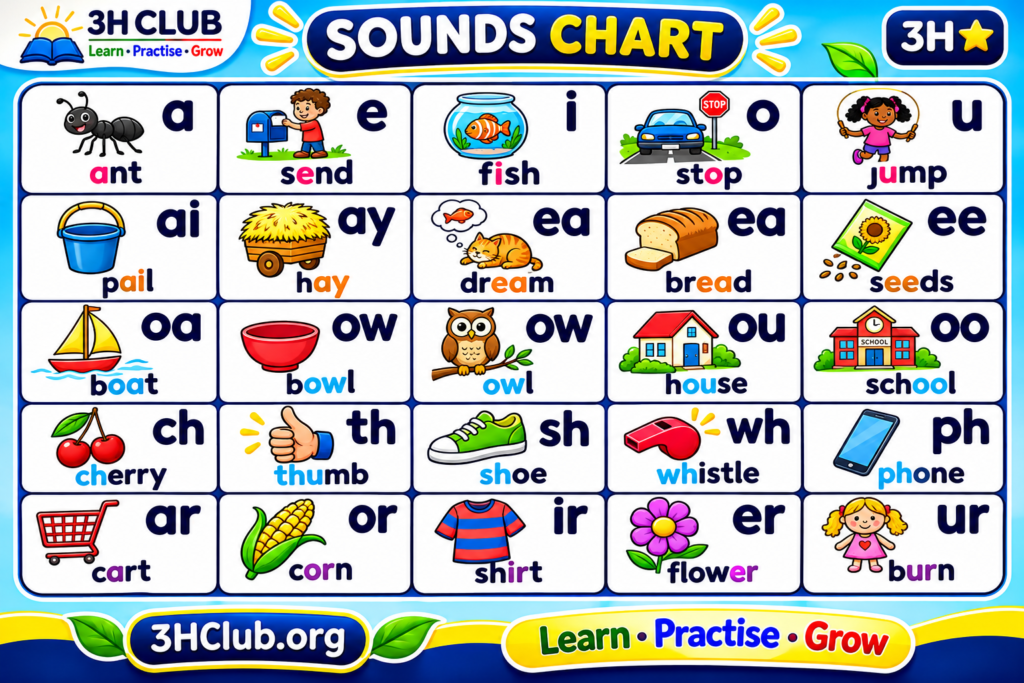
⭐⭐⭐ Champions: Become a Letter and Sound Detective
Around ages 10–11
You can now identify vowels and consonants, recognise common vowel patterns and explain the difference between consonant blends and digraphs. Let’s take those skills further.
🔍 Letters and Sounds Are Not the Same Thing
A letter is a written symbol. A sound is something you hear when a word is spoken.
Letters and sounds are closely connected, but they are not exactly the same.
For example, the word ship has four letters:
S • H • I • P
But it has three main speech sounds:
/sh/ • /i/ • /p/
The letters S and H work together to represent the first sound.
Now consider train. It has five letters, but the vowel team ai works together to represent one vowel sound.
This is why counting letters is not always the same as counting sounds.
🧠 Vowel Patterns Can Be Tricky
English has many spelling patterns. Here are a few useful ones.
1. The silent-e pattern
A final E often changes the vowel sound earlier in the word.
- hop → hope
- kit → kite
- cub → cube
The final E is not usually pronounced as a separate sound in these examples, but it affects how the word is read.
2. Vowel teams
Two or more letters can work together to represent a vowel sound.
- ai in paint
- ee in green
- oa in coast
- igh in night
Notice that a vowel team does not always contain two vowel letters. The spelling igh, for example, has three letters working together to represent the vowel sound in night.
3. One spelling, different sounds
Some letter combinations can represent different sounds in different words.
Compare:
- head and team
- cow and snow
- book and moon
The letter patterns are similar, but the sounds are not always the same. That is why good readers use spelling patterns alongside the word’s context and pronunciation.
🐝 Consonant Patterns: Blends and Digraphs
Let’s review two important consonant patterns.
Consonant blends
In a blend, each consonant sound can still be heard.
Examples:
- cl in clap
- dr in drum
- spl in splash
- str in street
The word splash begins with three consonant letters: S, P and L. You can hear the consonant sounds together at the start.
Consonant digraphs
In a digraph, two letters work together to represent one consonant sound.
Examples:
- sh in shell
- ch in chicken
- th in think
- ph in graph
The word chicken starts with the two-letter digraph ch.
Some words also contain more than one pattern. In bright, for example, br is a consonant blend, and igh is a vowel spelling pattern.
📝 Why Vowels and Consonants Matter for Spelling
Knowing about vowels and consonants can help you notice why words are spelled the way they are.
Consider the words:
- hop and hopping
- hope and hoping
When we add an ending, the spelling sometimes changes.
- In hop → hopping, the final consonant P is doubled.
- In hope → hoping, the final E is dropped before adding -ing.
These are common spelling rules, but English has exceptions. If you are unsure, check a dictionary or a trusted spelling resource.
🔤 Can Y Be a Vowel?
Yes. Y is usually a consonant when it represents the sound at the beginning of yes or yellow. It acts as a vowel in words such as gym, my and happy.
In happy, Y represents the final vowel sound. In my, it represents the vowel sound in the word.
The important thing is to look at how the letter works in each word.
🎯 Champions Challenge: Investigate the Words
1. Count the letters and sounds
How many letters and main speech sounds are in ship?
2. Find the vowel spelling pattern
Which letter group represents the vowel sound in night?
A. ni
B. igh
C. ht
3. Blend or digraph?
Identify the consonant pattern at the beginning of each word:
- clap
- shell
- drum
- chicken
4. Find the vowel teams
Write the vowel spelling pattern in each word:
- paint
- green
- coast
- night
5. Why is the final E important?
Explain how the final E changes the vowel sound in hop and hope.
6. Is Y a vowel or consonant?
Decide how Y is being used in each word:
- yellow
- gym
- happy
- yes
7. Investigate the spelling change
What happens to the spelling when you change:
- hop → hopping
- hope → hoping
8. Find the patterns
Read this sentence:
The bright green frog splashed into the pond.
Find:
- One word with a consonant blend.
- One word with a consonant digraph, if there is one.
- One word containing a vowel team.
9. Explain the difference
Why is sh in ship a digraph, while st in stop is a blend?
10. Write your own examples
Write:
- One word with a short vowel sound.
- One word with a long vowel sound.
- One word with a consonant blend.
- One word with a consonant digraph.
- One word where Y acts as a vowel.
✅ Check Your Answers
- Ship has four letters and three main speech sounds: /sh/, /i/ and /p/.
- B — igh.
- clap — blend; shell — digraph; drum — blend; chicken — digraph at the beginning.
- paint — ai; green — ee; coast — oa; night — igh.
- In this common spelling pattern, the final E helps the O in hope say its long sound, unlike the short O in hop.
- yellow — consonant; gym — vowel; happy — vowel; yes — consonant.
- hop doubles the P before adding -ing to make hopping. Hope drops the final E before adding -ing to make hoping.
- bright or green could provide a consonant blend (br or gr); the contains the digraph th; green contains the vowel team ee. In bright, igh is a vowel spelling pattern.
- In ship, SH represents one consonant sound. In stop, S and T represent two separate consonant sounds.
- Answers will vary. Examples: cat (short vowel), cake (long vowel), stop (blend), ship (digraph), my (Y acting as a vowel).
⭐⭐⭐ Champion Tip: Strong readers do more than name letters. They look for patterns, listen to sounds and use what they know to work out unfamiliar words.

🧠 Big Vowels and Consonants Challenge
Ready for a final test? Try these questions without looking back at the lessons.
⭐ Starters
1. Write the five main vowel letters.
2. Is B a vowel or a consonant?
3. Find the vowel in fish.
⭐⭐ Builders
4. Which word has a long A sound: cap, cake or cat?
5. Is ch in chair a blend or a digraph?
6. Is Y acting as a vowel or consonant in my?
⭐⭐⭐ Champions
7. How many letters are in night? Which letters represent its main vowel sound?
8. Explain the difference between a vowel letter and a vowel sound.
9. Identify one consonant blend and one vowel spelling pattern in street.
10. Write a sentence containing a word with a consonant digraph and a word with a vowel team. Underline or highlight each pattern.
✅ Big Challenge Answers
- A, E, I, O, U.
- B is a consonant.
- I.
- Cake.
- Digraph — CH represents one consonant sound.
- Y acts as a vowel in my.
- Night has five letters. The spelling igh represents its main vowel sound.
- A vowel letter is a written symbol, such as A or E. A vowel sound is the sound heard when a word is spoken.
- str is a consonant blend. The word street does not contain a vowel team made from two vowel letters; its vowel sound is represented by E.
- Answers will vary. Example: “The sheep stood near the green tree.” SH is a consonant digraph and EE is a vowel team.
How did you do? If some questions were tricky, revisit the relevant section and try again. Every time you practise, you build stronger reading and spelling skills.
📌 Vowels and Consonants — Remember This!
- 🅰️ The five main vowel letters are A, E, I, O and U.
- 🔤 The other 21 alphabet letters are usually classed as consonants.
- 🔄 Y can act as a consonant or a vowel, depending on the word.
- 🔊 Vowel letters can represent different vowel sounds.
- 🧩 Vowel teams use groups of letters to represent vowel sounds.
- 🐝 Consonant blends keep the separate consonant sounds audible.
- 🔠 Consonant digraphs use two letters to represent one consonant sound.
- ✏️ Recognizing spelling patterns can help you read and spell unfamiliar words.
🌟 Most Important Rule
Letters are the symbols we write; sounds are what we hear. Learning how they work together helps you unlock more words, one pattern at a time.
🔤 Keep Learning Grammar
Fantastic work! You now know more about vowels, consonants and the patterns that help us read and spell words.
Letters are just the beginning. They join together to make words, and words work together to make sentences.
Continue your learning journey:
Vowels & Consonants → Nouns → Verbs → Adjectives → Pronouns → Sentences → Punctuation
Explore these related lessons:
- Learn about Nouns for Kids
- Learn about Verbs for Kids
- Learn about Adjectives for Kids
- Learn about Pronouns for Kids
- Visit 3HClub.org
❓ Vowels and Consonants — Questions and Answers
What are vowels?
The five main vowel letters in English are A, E, I, O and U. The letter Y can also act as a vowel in words such as my, gym and happy.
What are consonants?
Consonants are the alphabet letters other than the five main vowel letters when those letters are used as consonants. Examples include B, C, D, F, M and T. Y can also act as a consonant, as in yes.
How many vowels are in the English alphabet?
There are five main vowel letters: A, E, I, O and U. Y sometimes acts as a vowel, depending on the word.
How many consonants are there?
The alphabet has 21 letters other than A, E, I, O and U. These are usually called the consonants, although Y can sometimes function as a vowel.
Can Y be a vowel?
Yes. In yes, Y acts as a consonant. In my and gym, Y acts as a vowel.
What is the difference between a vowel and a consonant?
Vowel and consonant letters represent different kinds of speech sounds. Vowel sounds are usually made with an open vocal tract, while consonant sounds often involve narrowing or closing part of the mouth. The letters also behave differently in common spelling patterns.
What is a short vowel sound?
A short vowel sound is a common vowel sound heard in words such as cat, bed, sit, hot and cup. These are useful examples, although English has many other vowel sounds and spelling patterns.
What is a long vowel sound?
A long vowel sound often sounds like the name of the vowel letter. For example, the A in cake and the I in bike are commonly described as long vowel sounds.
What is a vowel team?
A vowel team is a group of letters that work together to represent a vowel sound. Examples include ai in rain, ee in green and oa in boat.
What is a consonant blend?
A consonant blend is a group of consonants in which each consonant sound can still be heard. Examples include st in star, bl in black and str in street.
What is a consonant digraph?
A consonant digraph is a pair of letters that represents one consonant sound. Examples include sh in ship, ch in chair and th in thumb.
Why should I learn about vowels and consonants?
Knowing about vowels and consonants can help you recognize spelling patterns, sound out unfamiliar words, read more confidently and improve your spelling. It is a useful foundation for learning more about English.
Keep practicing, keep asking questions and keep discovering new words. Learn • Practice • Grow with 3HClub!