Start Reading & Comprehension
Ready for a story?
Reading is an exciting way to discover new places, meet interesting characters and learn amazing facts!
At 3H Club, you will read short stories, explore interesting passages and answer questions that help you understand what you have read.
You will learn how to:
- 🔎 Find important information in a story.
- 💡 Discover the main idea of a passage.
- 🔮 Predict what might happen next.
- 🧩 Use clues to understand what a writer means.
- 📖 Learn new words and their meanings.
- ⭐ Explain your answers using information from the text.
Whether you are just beginning to read or are ready for more challenging passages, there is something here for you!
⚡ Quick Answer: What Is Reading Comprehension?
Reading comprehension means understanding what you read.
It is more than saying the words correctly. It means thinking about what the words tell you, remembering important details and explaining the meaning of a story or passage.
Read this short passage:
Lily put on her raincoat and picked up her umbrella. Dark clouds covered the sky.
Question: What kind of weather is Lily expecting?
Answer: Rain!
How do we know? The raincoat, umbrella and dark clouds are clues.
Great job! You have just used reading comprehension skills.
👉 Jump to What You Need
👉 Five Important Reading Skills
🌟 Choose Your Reading Level
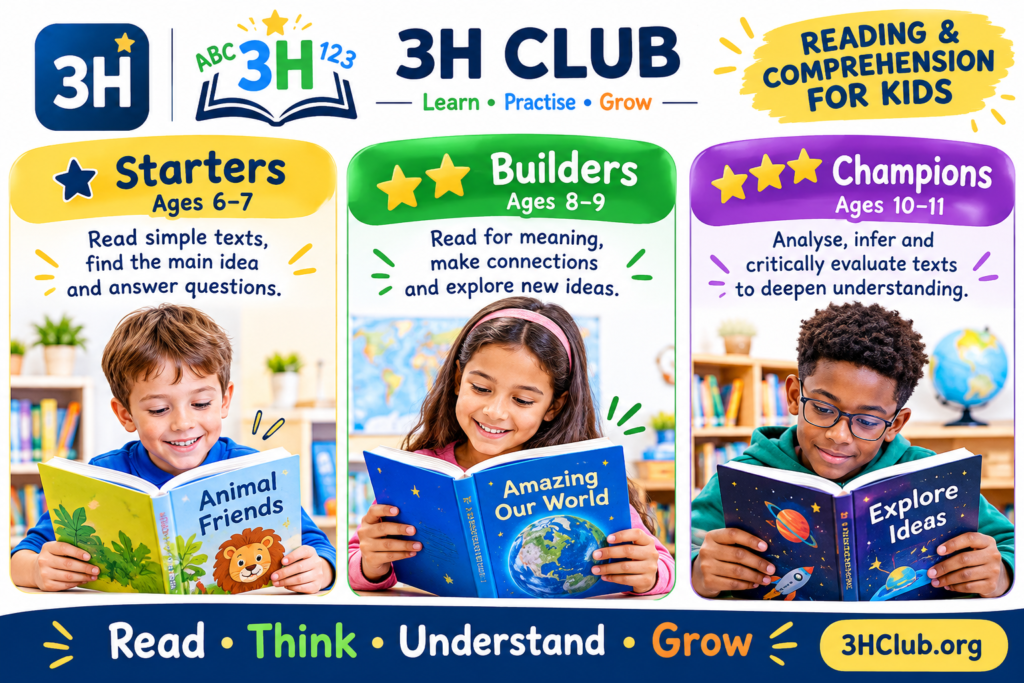
- ⭐ STARTERS — Ages 6–7: Short Stories & Simple Questions
- ⭐⭐ BUILDERS — Ages 8–9: Main Ideas, Predictions & Clues
- ⭐⭐⭐ CHAMPIONS — Ages 10–11: Inference, Evidence & Non-Fiction
Every reader learns at a different pace. Choose the level that feels comfortable, and move on when you are ready.
⭐ Starters — Ages 6–7
Let’s read together!
Begin with short, friendly stories, familiar words and simple questions. Learn to remember characters, places and events.
⭐⭐ Builders — Ages 8–9
Think about what you read!
Explore longer stories and interesting information. Find main ideas, make predictions and use clues to answer questions.
⭐⭐⭐ Champions — Ages 10–11
Become a reading detective!
Read more challenging stories and non-fiction passages. Discover hidden meanings, make inferences and explain your answers using evidence.
⭐ Starters — Reading Comprehension (Ages 6–7)
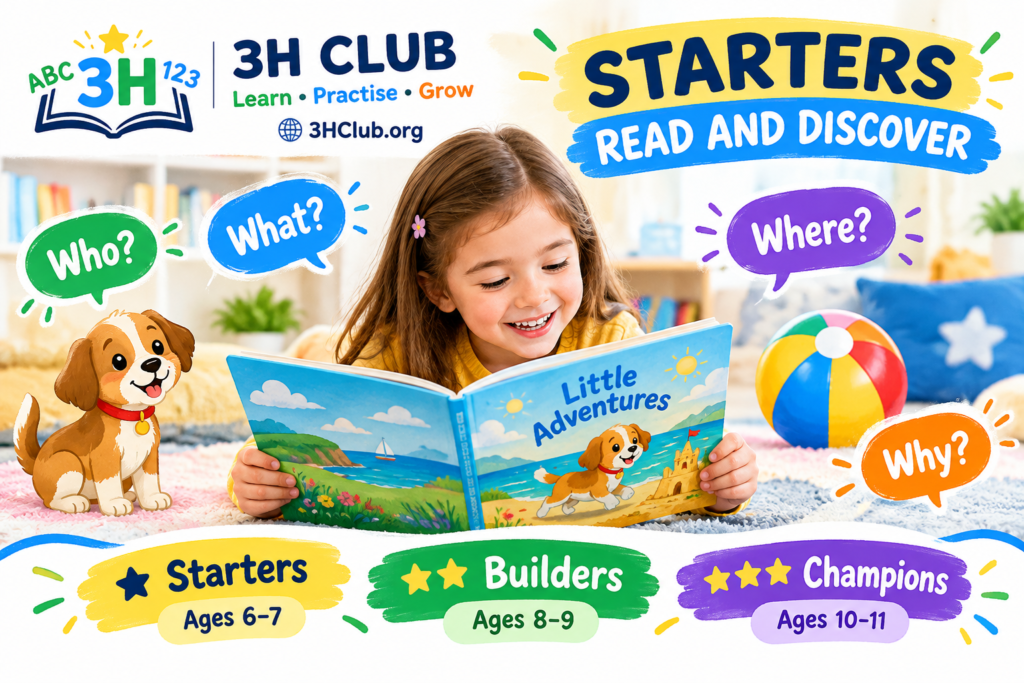
Little stories. Big discoveries!
Welcome, Starters!
Here you will practise reading short stories and answering questions about the people, animals, places and events you discover.
Don’t worry if you need to read a story more than once. Good readers often reread to understand better.
🐶 The Lost Puppy: Reading Comprehension
Oh no! A little puppy has wandered away from home.
Read a friendly story about a lost puppy and discover how the characters help it find its way home.
You will practise:
- Finding characters in a story.
- Remembering what happened.
- Answering simple questions.
- Putting events in order.
🏖️ A Day at the Beach: Reading Comprehension
Pack your sunhat! It’s time for a trip to the beach.
Read about a fun day by the sea and discover what happens during the adventure.
You will practise:
- Finding important details.
- Identifying where a story takes place.
- Remembering events.
- Answering who, what, and where questions.
❓ Who, What, Where, When and Why?
Every story has important information waiting to be discovered!
Learn to ask five useful questions that help you understand almost anything you read.
You will practise:
- Who is in the story?
- What happened?
- Where did it happen?
- When did it happen?
- Why did it happen?
👉 LEARN THE FIVE QUESTION WORDS
This lesson is also suitable for Builders who want to strengthen their reading skills.
🌈 Starters Reading Goal
By the end of this level, try to:
- Read a short passage with growing confidence.
- Identify the main characters.
- Tell where a story happens.
- Remember two or three important events.
- Answer simple questions about what you read.
⭐ Ready for a bigger challenge? Move on to Builders!
⭐⭐ Builders — Reading Comprehension (Ages 8–9)
Read carefully. Think deeply. Discover more!
Welcome, Builders!
Now that you can understand shorter stories, it’s time to explore longer passages and discover how writers share information.
You will learn to recognise important ideas, predict events and use clues to work out meaning.
💡 Finding the Main Idea
What is a story or paragraph mostly about?
Learn how to separate the main idea from smaller supporting details.
You will practise:
- Finding the most important message.
- Recognising supporting details.
- Choosing a suitable heading.
- Summarising a short paragraph.
🔮 Making Predictions While Reading
What do you think will happen next?
Become a reading detective by using story clues and what you already know to make sensible predictions.
You will practise:
- Spotting useful clues.
- Predicting events.
- Explaining your predictions.
- Checking whether your predictions were correct.
🔎 Finding Clues in a Story
Sometimes writers don’t tell us everything directly.
Learn how to spot words, actions and descriptions that help you understand what is happening.
You will practise:
- Finding clues in sentences.
- Understanding characters’ feelings.
- Using context to understand unfamiliar words.
- Supporting answers with story details.
⚖️ Fact or Opinion?
Can you tell the difference between something that can be checked and something a person believes or feels?
You will practise:
- Identifying facts.
- Recognising opinions.
- Explaining the difference.
- Sorting statements into groups.
🔗 Cause and Effect in Reading
Why did something happen? What happened because of it?
Learn to connect events and understand how one action can lead to another.
You will practise:
- Identifying causes.
- Recognising effects.
- Finding words such as because and so.
- Explaining connections between events.
This lesson also prepares you for Champions reading activities.
🌈 Builders Reading Goal
By the end of this level, try to:
- Identify the main idea of a passage.
- Find details that support an answer.
- Make sensible predictions.
- Recognise facts and opinions.
- Explain simple causes and effects.
- Use clues to understand characters and events.
⭐⭐ Excellent progress! Champions section is waiting for you!
⭐⭐⭐ Champions — Reading Comprehension (Ages 10–11)
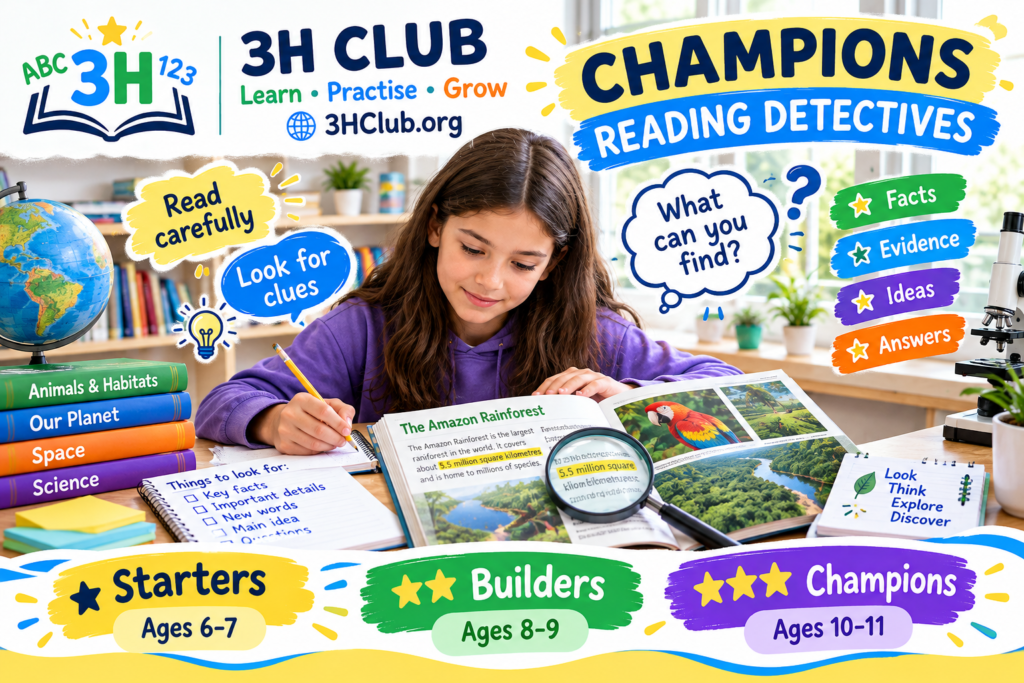
Read beyond the words!
Welcome, Champions!
You are ready to explore deeper meanings, challenging questions and interesting non-fiction passages.
At this level, you will learn to explain not only what a passage says but also what it suggests.
🧩 Making Inferences from a Text
Can you work out something the writer hasn’t said directly?
Learn how to combine clues from a passage with what you already know.
You will practise:
- Finding evidence in a passage.
- Understanding characters’ feelings and motives.
- Drawing sensible conclusions.
- Explaining how clues support an inference.
🌍 Non-Fiction Reading Comprehension
Ready to discover amazing facts about the world?
Read informative passages about animals, nature, science, history and everyday life.
You will practise:
- Finding key information.
- Recognising the main idea.
- Understanding headings and paragraphs.
- Learning subject vocabulary.
- Answering questions using evidence.
🔗 Cause and Effect: The Champions Challenge
Return to cause and effect with more complex passages.
Explore situations where one event has several causes or several consequences.
👉 TRY THE CAUSE AND EFFECT CHALLENGE
🌈 Champions Reading Goal
By the end of this level, try to:
- Explain ideas using evidence from a passage.
- Make inferences and justify them.
- Understand challenging vocabulary from context.
- Identify main ideas in longer texts.
- Compare information from different paragraphs.
- Write clear, thoughtful answers.
⭐⭐⭐ Fantastic work! Keep reading, questioning and discovering!
🧠 Five Important Reading Comprehension Skills
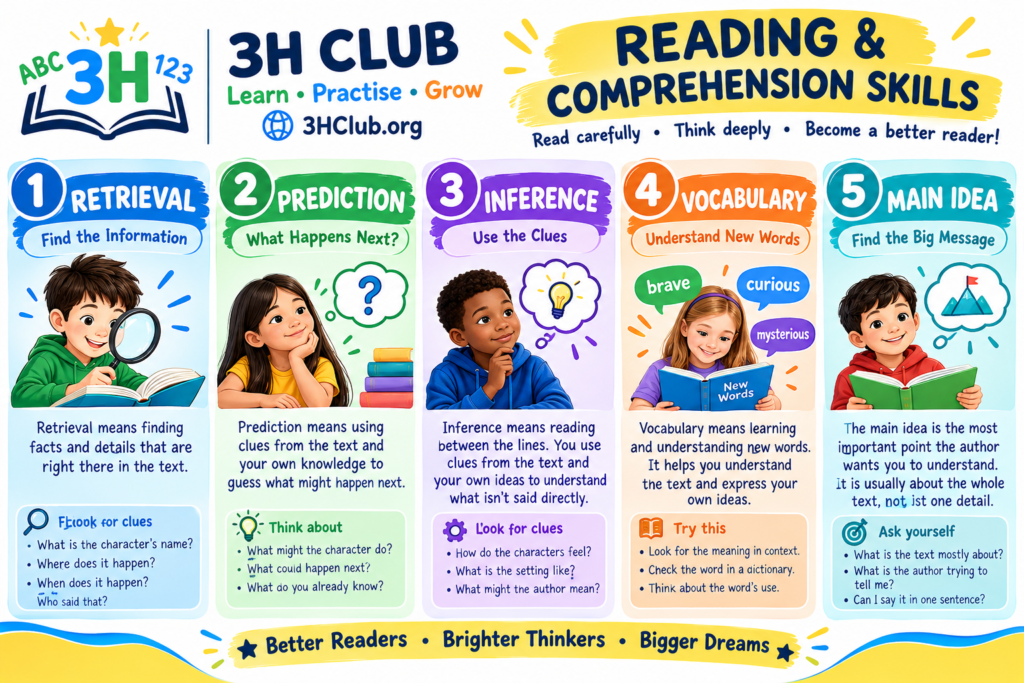
1. 🔎 Retrieval — Find the Information
Retrieval means finding information that the writer has already given you.
Example: Sam has a red bicycle.
Question: What colour is Sam’s bicycle?
Answer: Red.
2. 🔮 Prediction — Think About What Comes Next
Prediction means using clues to make a sensible guess about what may happen.
Example: The sky grew dark, and thunder rumbled.
Prediction: A storm may be coming.
3. 🧩 Inference — Read Between the Lines
Inference means using clues and what you already know to understand something that is not directly stated.
Example: Maya smiled as she opened her birthday present.
Inference: Maya is probably happy.
4. 📖 Vocabulary — Understand New Words
Vocabulary means knowing what words mean.
When you meet an unfamiliar word, look at the other words in the sentence for clues.
Example: The enormous elephant stood beside the tiny mouse.
Question: What does enormous mean?
Answer: Very big.
5. 💡 Main Idea — Discover the Big Message
The main idea tells you what a passage is mostly about.
Example: Bees visit flowers, collect nectar and help plants produce seeds.
Main idea: Bees are important to plants.
✏️ Try a Reading Comprehension Challenge!
Read the passage carefully. Then answer the questions.
🐦 The Little Bird
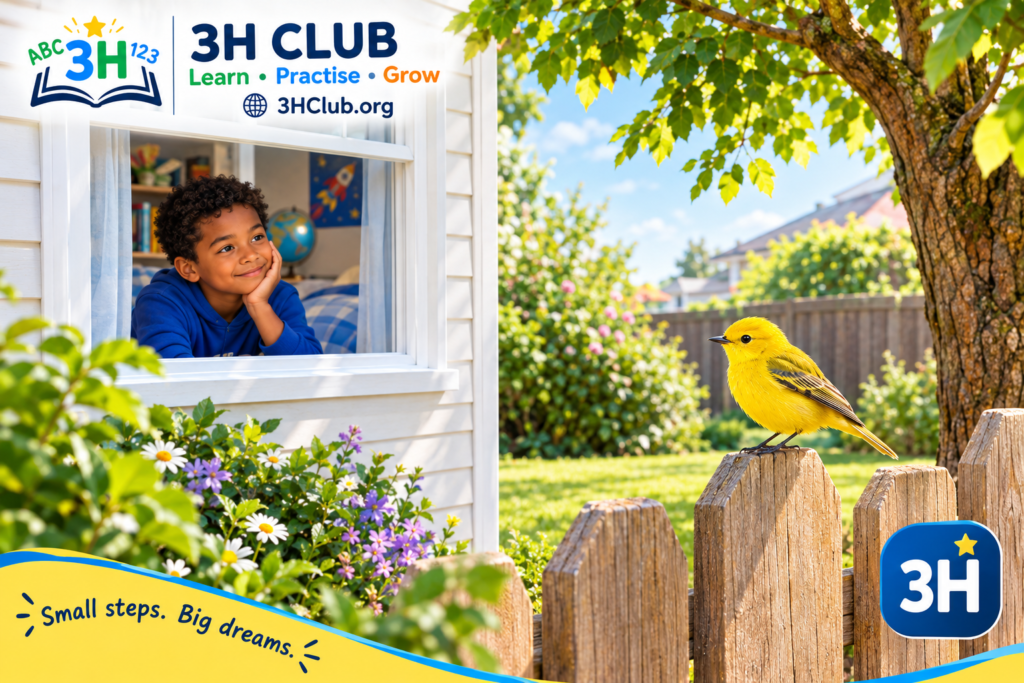
One morning, Noah looked out of his bedroom window and saw a small bird sitting on the garden fence.
The bird had bright yellow feathers and a tiny black beak.
Noah watched as the bird hopped onto the grass and searched for food.
A few minutes later, the bird picked up a worm and flew into a nearby tree.
Noah smiled. He hoped the little bird would visit again tomorrow.
Your Questions
1. Where was the bird sitting when Noah first saw it?
2. What colour were the bird’s feathers?
3. What did the bird find on the grass?
4. Why do you think the bird was searching the grass?
5. What do you predict Noah might do tomorrow morning?
✔ Check Your Answers
1. On the garden fence.
2. Bright yellow.
3. A worm.
4. It was probably looking for food.
5. He might look out of his window to see whether the bird returns.
⭐ How did you do?
If you found some questions tricky, read the passage again and look for clues. That’s how readers improve!
📚 Reading Tips for Every Level
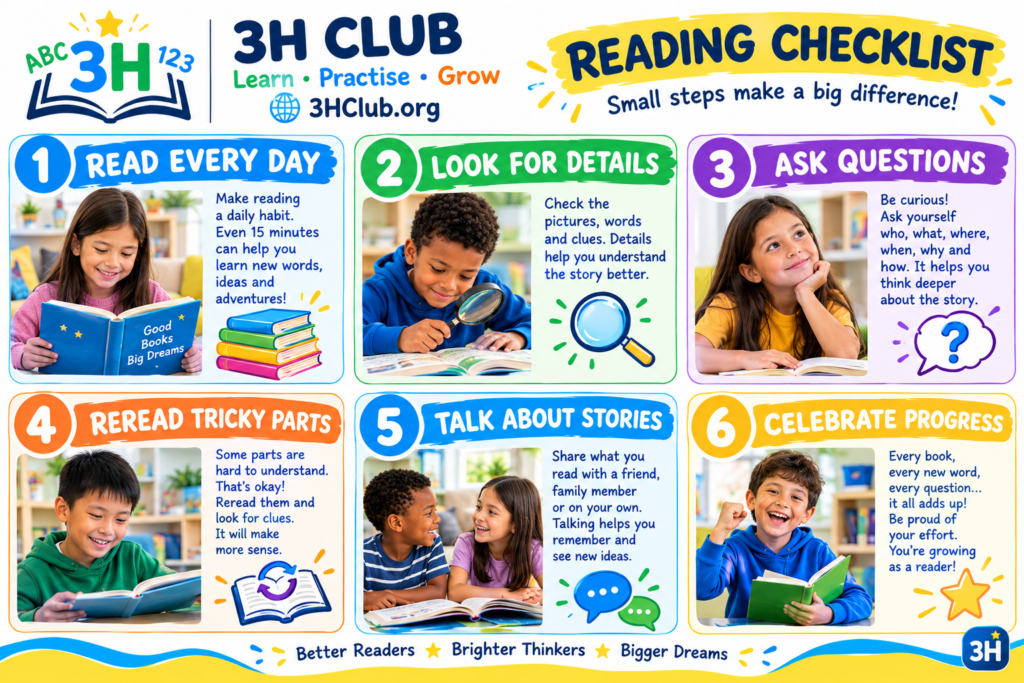
Want to become a stronger reader? Try these simple habits.
📖 Read a Little Every Day
Even 10–15 minutes of enjoyable reading can give you regular practice.
🔎 Look for Important Details
Pay attention to names, places, events and useful information.
❓ Ask Questions as You Read
Think about what is happening and why.
🔁 Reread Tricky Parts
If something doesn’t make sense, read it again slowly.
💬 Talk About What You Read
Tell someone what happened in the story or explain an interesting fact.
🌟 Celebrate Your Progress
Every new word and every question you answer helps you grow as a reader!
❓ Frequently Asked Questions
What is reading comprehension for kids?
Reading comprehension is the ability to understand and explain what you read. It includes finding information, understanding ideas, making predictions and answering questions.
What is the difference between reading and comprehension?
Reading involves recognising and understanding written words. Comprehension involves making sense of the information and ideas those words communicate. The two skills work together.
Which reading level should I choose?
Choose Starters if you are beginning to read short passages, Builders if you are ready for longer stories and questions, or Champions if you want to explore deeper meanings and more challenging texts.
The ages are guides, not strict rules.
How can I improve my reading comprehension?
Read regularly, learn new words, ask questions, discuss stories and practise finding evidence in a passage.
Can I try lessons from different levels?
Of course! You can practise easier lessons to build confidence or try more challenging activities when you feel ready.
🌟 Keep Learning With 3H Club!
Reading opens the door to new adventures and discoveries.
Keep practising your skills, explore new stories and challenge yourself to understand something new every day.
📚 Read • 🧠 Think • ⭐ Grow
3H CLUB — Learn • Practise • Grow